
By Hassan Hussain
The Federal Government says it will leverage digital technology, artificial intelligence and telemedicine to improve cancer prevention, early diagnosis and treatment across the country.
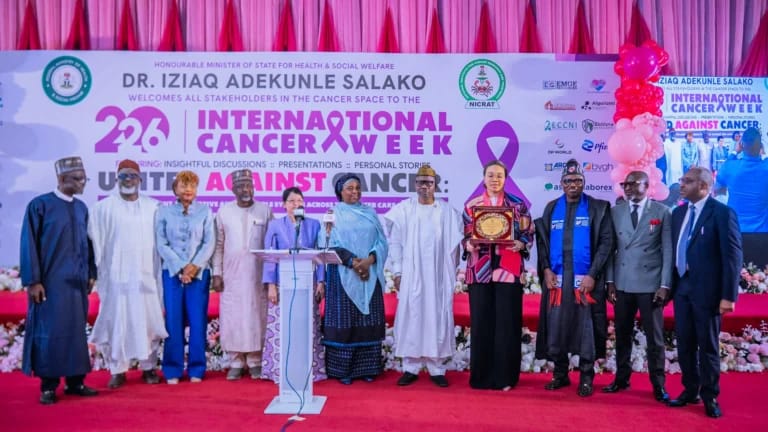
The Minister of State for Health and Social Welfare, Dr Iziaq Salako, stated this in Abuja at the opening of the 2026 International Cancer Week, themed “United Against Cancer: Building Resilient, Innovative and Equitable Systems Across the Cancer Care Continuum”.
Salako said the government is also investing in cancer infrastructure, diagnostic equipment, medicines, skilled personnel and sustainable financing to improve access to quality care.
He noted that emerging technologies, including molecular diagnostics, precision medicine and data analytics, would help bridge geographical barriers, strengthen referrals and improve clinical decision-making.
The minister explained that the government is expanding early detection and prevention through eight National Institute for Cancer Research and Treatment Preventive Oncology Clinics across the six geopolitical zones.
He added that the introduction of immunohistochemistry services under the Nigeria Cancer Access Partnership Programme, supported by Roche, is another step towards improving cancer diagnosis.
Salako said the National Cancer Health Fund and Catastrophic Health Expenditure Fund are also providing financial protection for vulnerable patients and their families.
The Director-General of NICRAT, Prof. Usman Aliyu, said the institute has intensified cancer-control efforts through research, workforce development, surveillance and improved access to treatment.
Aliyu revealed that nearly 2,000 healthcare professionals have been trained across the six geopolitical zones in cancer prevention, diagnosis, treatment, palliative care and research.
He said NICRAT is advancing precision oncology through the Nigeria Cancer Genome Study, while the SINCA project has trained more than 120 early-career oncology researchers.
The NICRAT director-general added that the declaration of cancer as a notifiable disease and the upgrading of population-based cancer registries have strengthened cancer surveillance in Nigeria.
He further revealed that the National Cancer Health Fund has supported more than 2,000 indigent and vulnerable patients, while another cancer assistance initiative has provided life-saving support to over 10,000 patients.
Also speaking, the Chairman, House of Representatives Committee on Health, Mr Amos Magaji, called for increased funding and stronger primary healthcare interventions to address the growing cancer burden.
Magaji said Nigeria is losing approximately 1,000 people to cancer every month, while the high cost of treatment continues to push many families into poverty.
He called for stronger health insurance coverage, reduced out-of-pocket expenditure and timely release of funds to ensure that cancer patients receive treatment without unnecessary delays.
“We need to get to a point whereby we strengthen our primary healthcare centres, and that is where screening, health education campaign and every other thing needs to start from,” he said.
In his remarks, the President of the Nigerian Cancer Society, Prof. Abidemi Omonisi, stressed the need for stronger collaboration among government agencies, healthcare professionals, researchers, development partners, civil society organisations, communities and cancer survivors.
Omonisi said cancer-control efforts must translate commitments into measurable action and sustainable outcomes, noting that no single institution could tackle the burden alone.
He emphasised that innovations in digital health, artificial intelligence and diagnostic services must be guided by evidence and tailored to the realities of Nigeria’s healthcare system.
The event featured the launch of the Standard Operating Procedure Manual for Cancer Registries in Nigeria and the Nigerian Journal of Cancer Research.
The 2026 International Cancer Week, which began on Tuesday, is scheduled to end on Friday.
