
By Danjuma Amodu
*PFI NPK’s early procurement of 534,219 metric tonnes of raw materials has secured Nigeria’s 2026 wet season fertiliser supply, avoiding shortages and price spikes hitting other African nations.
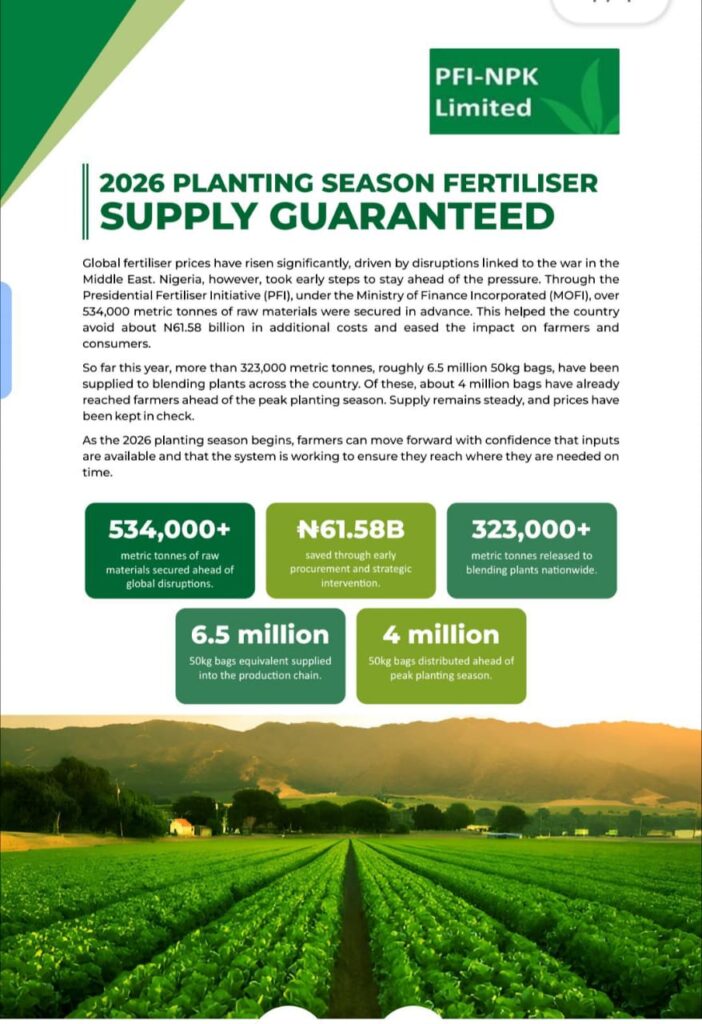
Abuja, Nigeria – While several African countries grapple with fertiliser shortages and soaring input costs triggered by fresh disruptions to global shipping routes, the Federal Government has secured its fertiliser supply for the 2026 wet season through early procurement decisions that saved the country more than $42 million.
Escalating tensions along critical maritime corridors have driven up freight costs and pushed up prices of key inputs, including Granular Ammonium Sulphate (GAS), Diammonium Phosphate (DAP), and Muriate of Potash (MOP). Across multiple markets, supply gaps are widening, leaving farmers uncertain about availability and pricing ahead of planting.
Nigeria, however, moved ahead of the crisis.
PFI NPK Limited, the wholly owned entity of the Ministry of Finance Incorporated (MOFI) and implementation vehicle for the Presidential Fertiliser Initiative, confirmed that it locked in its 2026 supply position months before the current market volatility.
“We took a deliberate decision to move early, well ahead of market pressures, by securing supply, locking in pricing, and putting the necessary financial instruments in place. That foresight is what has ensured that Nigeria is not exposed to the disruptions currently affecting global fertiliser markets.” — Dr. Armstrong Ume Takang, Director, PFI NPK Limited
According to Q1 2026 procurement and shipment records, the company secured nine vessels carrying a combined 407,304 metric tonnes. Together with the opening balance at the start of the 2026 cycle, a total of 534,219 MT of raw materials is available for NPK fertiliser production. All associated Letters of Credit have been fully established or settled, ensuring supply continuity.
The records further show that, as of mid-April 2026, over 323,109.24 metric tonnes — approximately 6.5 million 50kg bags — had been released to registered blending plants nationwide. More than 198,264.41 metric tonnes, or roughly 4 million 50kg bags, had already been offtaken, indicating active distribution across the country ahead of peak planting.
Financial data reviewed alongside the procurement records indicate that the early purchasing strategy generated total savings of $43.99 million, equivalent to approximately ₦61.58 billion, when compared with prevailing spot market prices.
A breakdown shows GAS was secured at $228 per metric tonne against a current market price of $343. DAP was locked in at $775 per tonne compared with $950, while MOP was secured at $400 per tonne against $430. The price differentials reflect the impact of securing supply before global escalations.
Fertiliser availability and pricing remain central to Nigeria’s agricultural productivity and food supply. With global market conditions placing increasing pressure on input costs, consistent supply and price stability are critical to supporting production outcomes.
PFI NPK operates a centralised bulk procurement and distribution model. It imports raw materials and supplies them to 94 FEPSAN-registered blending plants across Nigeria. The company does not import finished fertiliser, ensuring that all NPK production is carried out domestically to support local industry and value addition.
In 2025, the company delivered 648,000 metric tonnes of raw materials. For 2026, operations are being scaled significantly, with a target of 1.52 million metric tonnes.
The supply chain operates under strict governance protocols. Collateral Management Agents provide independent oversight at warehouses, while raw materials remain under PFI NPK control until confirmed sales and repayment are executed. Standard operating procedures, developed with the Fertiliser Producers and Suppliers Association of Nigeria (FEPSAN), guide handling, storage and distribution. Regulatory compliance is maintained through NAFDAC and Standards Organisation of Nigeria (SON) requirements. Operations are further supported by the Office of the National Security Adviser (ONSA), whose approval remains central to PFI NPK’s ability to operate and scale distribution nationwide.
For farmers preparing for the 2026 wet season, the immediate outcome is supply certainty. Raw materials are either already in-country or in transit, blending plants are receiving inputs, and the risk of sudden price shocks linked to global disruptions has been significantly reduced.
Dr. Takang emphasised that the impact of the intervention ultimately rests at the farm level. “What matters is that the farmer can access fertiliser when needed and at a price that does not undermine production. By stabilising supply and managing cost exposure at the procurement stage, we are supporting that outcome at scale,” he said.
Looking ahead, the company is strengthening long-term supply security through Government-to-Government partnerships with international suppliers and advancing plans for a digital enterprise system to provide real-time visibility across procurement, inventory and distribution.
PFI NPK Limited is a wholly owned entity of the Ministry of Finance Incorporated (MOFI) and the designated implementation vehicle for Nigeria’s Presidential Fertiliser Initiative. The company operates a centralised bulk procurement and distribution system for fertiliser raw materials, ensuring domestic blending and nationwide supply stability.
