
By Danjuma Amodu | March 17, 2026
The 2026 Oloibiri Lecture & Energy Forum (OLEF 2026) has been described as a defining moment to reposition Nigeria’s oil and gas industry toward intelligence, resilience and shared prosperity, with stakeholders stressing that future growth will depend on digitalisation, disciplined financing and smarter regulation rather than volume alone.
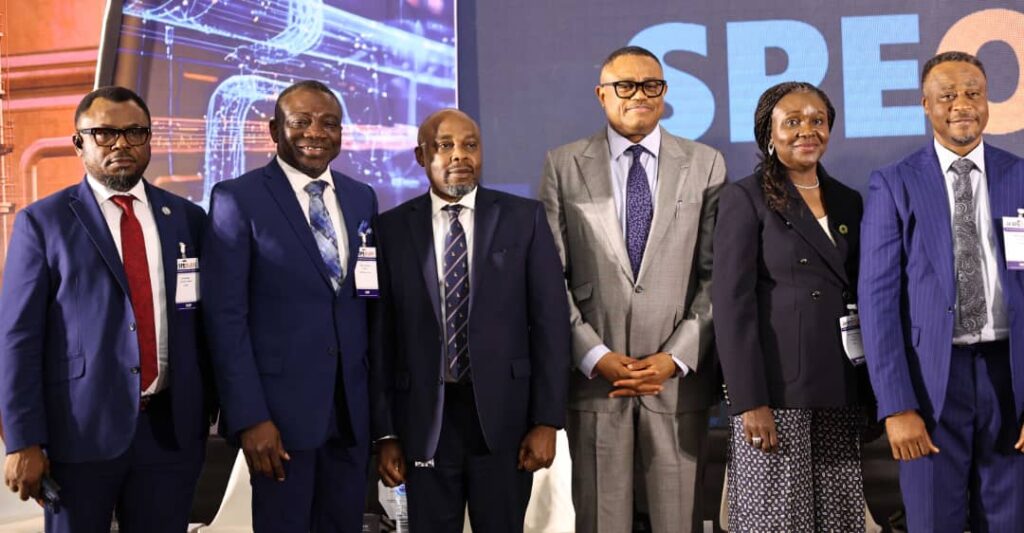
– L-R: The MD/CEO, Seaquest Exploration and Production Services, Mr. Etta Agbor; Director, Competitive Performance, Nigeria and Mid Africa Region, Chevron Upstream, Mr. Kunle Adeyemo; Head, Energy Sector, Client Coverage, Corporate and Investment Banking, Stanbic IBTC, Mr. Imoh Umah; Executive Vice President, Upstream, NNPC (representing NNPC GCEO), Mr. Udibong Ntia; Commission Chief Executive, Nigerian Upstream Petroleum Regulatory Commission (NUPRC), Mrs. Oritsemeyiwa Eyesan and Chairman, Society of Petroleum Engineers (SPE), Nigeria Council, Mr. Francis Nwaochei at the 2026 edition of the Society of Petroleum Engineers (SPE) Oloibiri Lecture Series & Energy Forum (OLEF) held in Abuja recently
In his welcome address, the Chairman of the Society of Petroleum Engineers (SPE), Nigeria Council, Mr Francis Nwaochei, said OLEF 2026 “represents our collective commitment to move beyond dialogue and deliver practical, scalable solutions that strengthen resilience and unlock long-term value for Nigeria.”u
Held under the theme “Beyond Three Million Barrels Target: Harmonizing Digitalization, Capital and Policy Frameworks for Intelligent Operations and Asset Optimisation,” the forum drew Ministers of Petroleum Resources, chief executives of regulatory institutions, leaders of national oil companies, and key stakeholders across the energy value chain.
The theme comes as Nigeria works to bridge a significant production gap. Current output remains well below the 3 million barrels per day (mb/d) aspiration, with NUPRC consistently reporting that achieving the target will require accelerated investment, improved security of supply, and faster development of idle fields. Gas output also trails the 22 billion cubic feet (BCF) per day benchmark set by regulators for domestic utilisation and export growth.
Speaking at the forum, the Group Chief Executive Officer of NNPC Limited, Engr. Bashir Bayo Ojulari, announced that Nigeria’s upstream oil and gas sector has attracted over $24 billion in capital investment following targeted interventions by the Nigerian Upstream Petroleum Regulatory Commission (NUPRC). Represented by the Executive Vice President, Upstream, Udobong Ntia, Ojulari credited the inflows to reforms addressing legacy asset disputes and unlocking stalled Final Investment Decisions. He stressed that achieving the 3 mb/d target will depend on capital, data, and effective regulation, expressing confidence in Nigeria’s capacity to compete globally.
Delivering the keynote address, the NUPRC Chief Executive, Oritsemeyiwa Eyesan, said production growth will require more than drilling. She called for agile regulatory frameworks that attract investment, enable digital oilfields, and drive sustainable value creation. Despite Nigeria’s vast reserves, she noted that past underperformance underscores the need for disciplined execution and alignment across policy, capital, and technology.
Also speaking, the Chief Executive of the Nigerian Midstream and Downstream Petroleum Regulatory Authority (NMDPRA), Engr. Saidu Mohammed, stressed that achieving Nigeria’s 3 mb/d oil and 22 BCF gas targets will require strong financing, advanced technology, and effective regulation to position the country as a resilient energy hub amid shifting global dynamics.
Mr Nwaochei added that while Nigeria continues to pursue ambitious production targets, the focus is expanding toward unlocking deeper value from existing assets through innovation, disciplined financing, and smarter regulation.
“The future of our industry will not be determined by the volume of resources we extract, but by the intelligence with which we manage them,” he said.
Technical panels on the second day of OLEF 2026 focused on operationalising the conference theme. In a communique issued at the close of the forum, participants called for a joint industry-government task force to fast-track digital oilfield adoption, standardise data exchange protocols, and de-risk capital for marginal field development.
The communique urged NUPRC and NMDPRA to harmonise reporting requirements for operators and set quarterly milestones toward the 3 mb/d target. Delegates also recommended a dedicated “Innovation Fund” backed by IOCs, independents and the Nigerian Content Development and Monitoring Board to finance proven technologies for asset optimisation and methane reduction.
The Oloibiri Lecture & Energy Forum (OLEF) is the flagship annual platform of the Society of Petroleum Engineers (SPE) Nigeria Council. Named after Oloibiri, the town in Bayelsa State where crude oil was first discovered in commercial quantities in Nigeria in 1956, the forum convenes policymakers, regulators, operators, and financiers.
OLEF has become the industry’s primary stage for setting technical and policy direction each year. Past editions have influenced local content implementation, gas commercialisation frameworks, and asset divestment guidelines. The 2026 edition’s focus on “intelligent operations” signals a shift from volume-led rhetoric to efficiency, digitalisation and capital discipline as the levers for growth.
