
The Institute for Peace and Conflict Resolution, IPCR, has called for urgent and sustained investment in peacebuilding, warning that Nigeria’s democratic stability and development prospects ahead of the 2027 general elections depend on stakeholders’ ability to address conflict before it escalates.
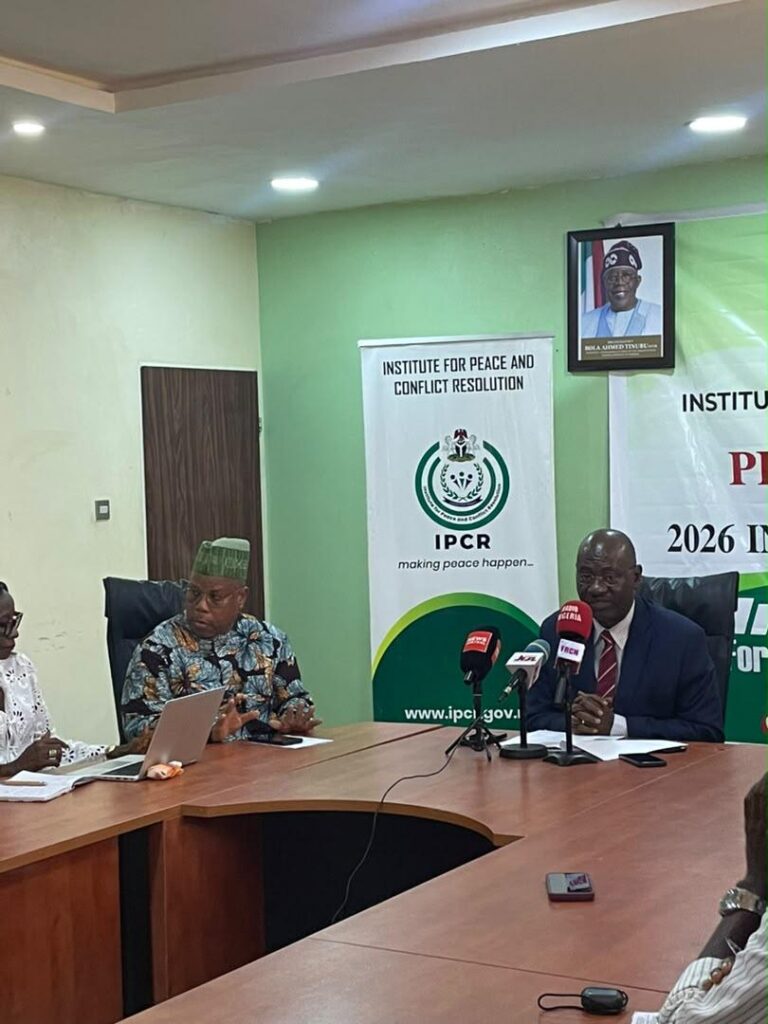
The Director-General of the Institute, Dr Joseph Ochogwu, made the call on Wednesday in Abuja at a world press briefing to herald the 2026 International Day of Peace, stressing that peace must be treated as a national infrastructure requiring deliberate funding, institutional commitment and collective action.
The 2026 commemoration, marked annually on September 21 in accordance with a United Nations General Assembly resolution, is themed, “Investing in Peace for Everyone, Everywhere, Every Day.”
Ochogwu said the theme represents a shift from viewing peace merely as the absence of war to recognising it as a continuous investment essential to national survival.
He noted that Nigeria’s interconnected security, social and economic challenges — including violent extremism, farmer-herder conflicts, banditry, youth restiveness, communal tensions, climate-induced competition for resources, misinformation and strains from economic reforms — made stronger peacebuilding mechanisms particularly urgent.
“Without peace, we cannot have food security. Without peace, we cannot have quality education, healthcare, or attract investment,” he stated.
According to him, the absence of peace undermines development by disrupting livelihoods, weakening public institutions, discouraging investment and limiting citizens’ access to essential services.
He urged governments, security agencies, the private sector, traditional and religious institutions, civil society organisations and the media to strengthen investments in early warning and early response systems, dialogue platforms, community mediation centres, youth engagement hubs and psychosocial support.
Such mechanisms, he said, should receive the same attention as physical infrastructure such as roads and electricity.
“Every naira, every hour, every platform invested in dialogue is an investment in Nigeria’s survival,” he declared.
Ochogwu maintained that peacebuilding should not be left to government alone. He urged federal and state governments to prioritise it in budgetary allocations and policy formulation and called on the National Assembly to strengthen legislation supporting social cohesion and conflict-sensitive governance.
He also appealed to security agencies to deepen non-kinetic and community-centred approaches, while acknowledging the sacrifices of security personnel.
He urged private sector operators to regard peace as a business imperative and called on traditional and religious leaders to promote tolerance and peaceful coexistence.
Addressing the media, Ochogwu called for greater investment in peace journalism to counter hate speech, misinformation and divisive narratives as the country approaches the 2027 general elections.
The IPCR boss identified several policy directions of the present administration that could contribute to peace by addressing structural drivers of conflict, including the Students Loan Scheme, MSME support programmes, the new minimum wage regime, social investment initiatives, local government autonomy, the Ministry of Youth Development and investments in the digital economy through NITDA and NCC.
He stressed that sustainable peace could not be achieved if sections of society were excluded, describing outreach to the six geopolitical zones, women, youths and persons with disabilities as investments in national cohesion.
On institutional direction, Ochogwu said the IPCR was being repositioned under its 2024–2028 strategic framework built around three pillars: knowledge, people and partnerships.
Under knowledge, the Institute will scale up research, early warning analysis and its Contemporary World Nigeria policy series. Under people, it will focus on the Renewed Hope Agenda for Young Peacebuilders, peace clubs in schools and capacity building for early warning. He disclosed that the Institute is coordinating the National Conflict Early Warning and Early Response Platform, NCEWER, linking state-level platforms.
The Institute’s activities for the 2026 International Day of Peace include religious prayers, a peace walk, a national peace lecture, humanitarian outreach and a novelty football match.
The programme began Wednesday with the flag-off of the Peace Day media campaign, “Every Day is Peace Day.” A peace prayer is scheduled for September 18 at the National Mosque in Abuja and nationwide, and another on September 20 at the National Christian Centre and across the country.
The main commemoration on September 21 will feature a peace walk and a national peace lecture titled, “Renewed Hope Agenda: Investing in Peace for Democratic Stability—Pathways to Justice and Inclusion Ahead of Nigeria’s 2027 General Elections,” at the IPCR Conference Hall.
A humanitarian outreach, “Investing in Peace by Visiting IDP Camp,” will hold in Abuja on September 22, while the grand finale, a novelty football match between IPCR and the National Great Green Wall Agency, is scheduled for September 25 at the Old Parade Ground, Abuja.
Ochogwu thanked partners supporting the commemoration including the UK-funded Strengthening Peace and Resilience in Nigeria, SPRiNG Programme, the United Nations System in Nigeria, the Nigerian Communications Commission, the Ufuk Dialogue Foundation, MDAs and civil society organisations.
He called on Nigerians at home and in the diaspora to make peace a way of life.
“Speak peace. Share peace. Fund peace. Teach peace,” he urged.
