
By Hassan Hussain | March 14, 2026
The Executive Director of a Non-Governmental Organisation, Sustainable Family Healthcare Foundation, Mrs. Peter Ogunmayi, has called for stronger commitment towards the implementation of the Disability Act in the Federal Capital Territory.
Mrs. Ogunmayi made the call in Abuja at a quarterly policy dialogue and roundtable discussion with stakeholders on the implementation status of the disability law. She explained that the foundation has been implementing a project aimed at advancing disability-inclusive development in the FCT, building on its earlier interventions in disability-focused disaster risk reduction.
According to her, the organisation and its development partners are committed to supporting persons with disabilities and ensuring they are included in development programmes. Mrs. Ogunmayi noted that since the commencement of the project, many complaints and challenges faced by persons with disabilities have been identified, stressing that efforts by the government in addressing the issues remain limited.
She said the foundation had therefore intensified advocacy and support initiatives across communities. Mrs. Ogunmayi explained that the organisation operates beyond the FCT, with activities also ongoing in Kogi State, where it engages persons with disabilities and promotes inclusive participation in all its programmes.
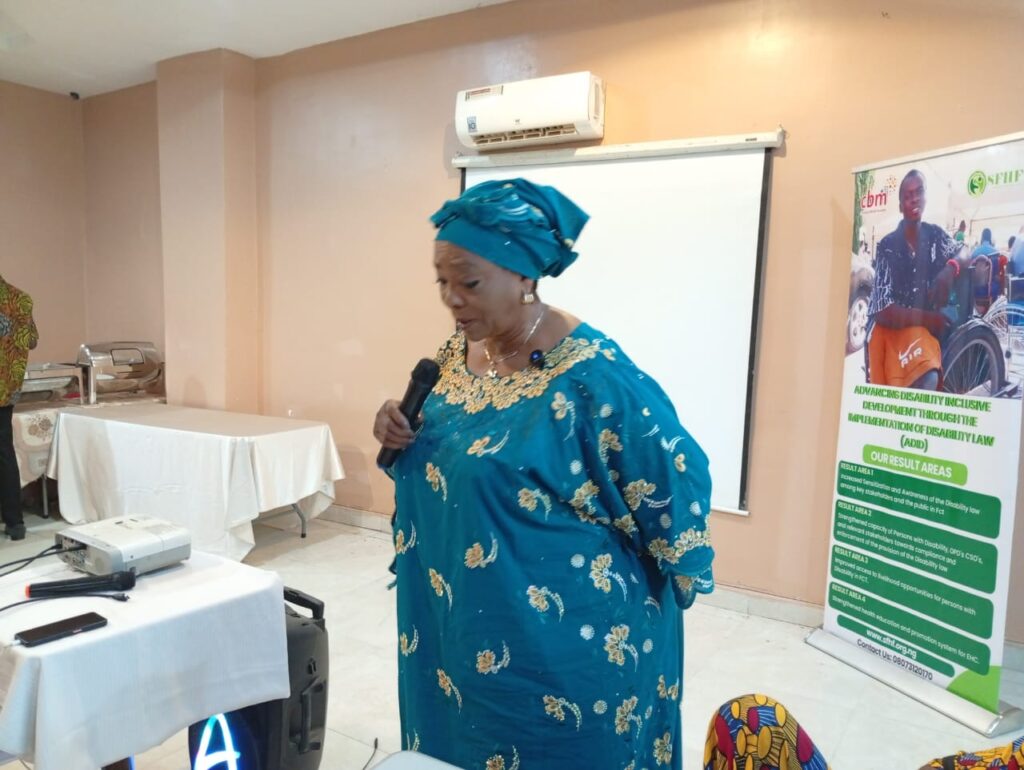
She added that the foundation ensures that persons with disabilities are involved in every project activity and are also employed within the organisation. Highlighting some of the achievements recorded, Mrs. Ogunmayi said more than five hundred persons with disabilities had received assistive devices, while over one thousand had benefited from vocational training programmes.
She further stated that more than four hundred beneficiaries had received empowerment support to enhance their livelihoods. Mrs. Ogunmayi also disclosed that the foundation had translated the disability policy into four languages and produced posters and flyers to raise awareness across communities.
She said the organisation was currently working in four area councils and several wards in the FCT to ensure wider dissemination of the policy and increased community participation. Mrs. Ogunmayi explained that although the Federal Government enacted the Disability Act in 2018 with a five-year transition period, the FCT was yet to fully domesticate and implement the law.
She noted that many states had already adopted and legalized the Act, stressing the need for the FCT to follow suit. According to her, the foundation hopes to use the FCT as a model for the implementation of the disability law across the country.
Mrs. Ogunmayi appealed to government at all levels to involve persons with disabilities in policy formulation and decision-making processes. She also urged communities to include them in Community Development Committees, recommending that at least five persons with disabilities (two women and three men) should be part of such committees.
The Executive Director further called on the media to amplify discussions from the dialogue to increase public awareness on the rights and potentials of persons with disabilities. Mrs. Ogunmayi emphasized that persons with disabilities are capable of contributing meaningfully to society when given the right support and opportunities.
She added that the era of treating persons with disabilities through charity alone was over, urging governments and organisations to focus on empowerment, employment, and full inclusion.
On her part, the Desk Officer for Persons with Disabilities Command, Nigerian Security and Civil Defence Corps, FCT Command, Superintendent Ojo Adekola, described stigmatisation as one of the major challenges confronting persons with disabilities in society, stressing the need for stronger collaboration among stakeholders to address the problem.
He explained that the command, under the leadership of the NSCDC FCT Commandant, Dr. Olusola Odumosu, had taken practical steps to bridge communication gaps between security agencies and the deaf community. According to him, about two hundred and fifty personnel of the NSCDC FCT Command have been trained in sign language to enhance communication and improve intelligence gathering within the deaf community.
Superintendent Adekola noted that the initiative, designed to ensure that persons with hearing impairments can easily report security concerns to relevant authorities, was commendable. She added that the command is also extending awareness programmes to Area Council communities within the FCT to educate residents on the rights of persons with disabilities and discourage discrimination.
The NSCDC Desk Officer further revealed that the command is strengthening collaboration with partners, including the University of Abuja, to support persons with disabilities through improved access to education, scholarships, and reduction of school fees. She said the Corps is also working with other organisations to ensure full compliance with the Disability Act in the Federal Capital Territory.
In a remark, the Acting Director of Compliance and Enforcement at the National Commission for Persons with Disabilities, Mr. Ikem Ochegbulam, acknowledged that attitudinal barriers within society remain a challenge, stressing the need for continuous awareness and positive engagement to change perceptions about persons with disabilities.
Mr. Ochegbulam emphasized that building an inclusive society requires collective commitment, urging Nigerians to adopt more supportive attitudes towards persons living with disabilities.
Also, the Mandate Secretary for Women Affairs Secretariat of the Federal Capital Territory Administration (FCTA), Adedayo Benjamins-Laniyi, represented by the Legal Adviser Permanent Secretary at the secretariat, Muhammad Baba, reaffirmed the commitment of the FCT administration to continue protecting the rights of persons with disabilities and promoting an inclusive society free from discrimination.
