
By Danjuma Amodu
The Economic Community of West African States (ECOWAS) has taken a significant step toward strengthening Africa’s collective peace and security architecture with the signing of a new Memorandum of Understanding (MoU) between the African Union (AU) and the continent’s Regional Economic Communities (RECs) and Regional Mechanisms (RMs) on the use of the African Standby Force (ASF).
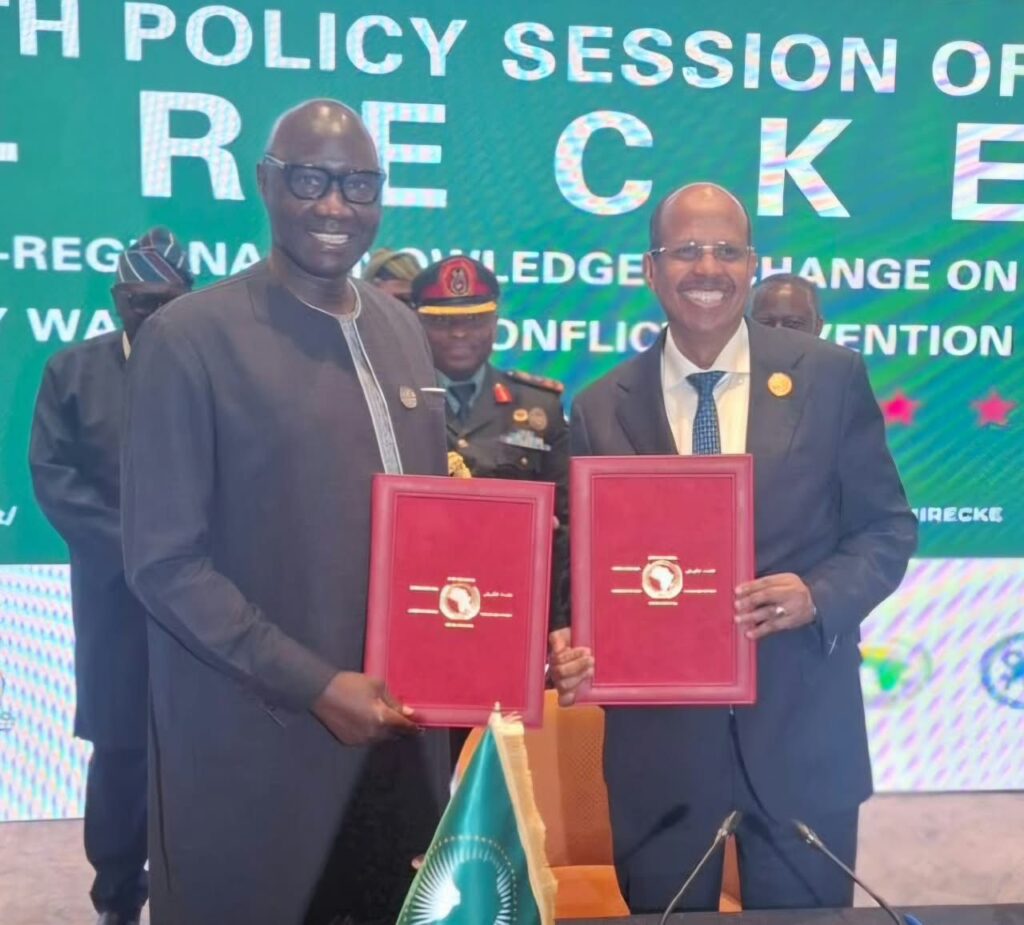
The agreement was signed on October 3, 2026, in New Alamein, Egypt, during the fifth AU Regional Knowledge Exchange High-Level Platform on the African Standby Force, held on the margins of the eighth AU Mid-Year Coordination Meeting.
The ECOWAS Commission was represented by its President, General Birame Diop, who signed the instrument on behalf of the West African regional bloc.
Other parties to the agreement include the African Union, the Economic Community of Central African States (ECCAS), the North African Regional Capability (NARC) and the Southern African Development Community (SADC). The AU identifies these regional structures, alongside the Eastern African Standby Force, as the five regional components underpinning the continental ASF architecture.
The MoU is intended to settle, in clearer institutional terms, how the AU and regional organisations will work together in preparing, mandating, deploying, employing and managing forces after deployment under the African Standby Force framework.
For a continent facing conflicts that increasingly cross national and regional boundaries, the agreement places renewed emphasis on the ability of African institutions to translate political decisions into coordinated and timely peace-support operations.
The African Standby Force is not a single permanent army stationed at one location. Rather, it is a continent-wide arrangement built around multidisciplinary capabilities — including military, police and civilian personnel — maintained by participating countries and regional organisations and intended to be available for rapid deployment when authorised.
Its legal foundation goes back to the 2002 Protocol establishing the AU Peace and Security Council. Article 13 provides for standby multidisciplinary contingents, with military and civilian components, to enable the Peace and Security Council to carry out its responsibilities relating to peace-support missions and intervention.
The ASF is designed to support a range of missions, including observation and monitoring, peace-support operations, conflict prevention, peacebuilding, humanitarian assistance and intervention in grave circumstances in accordance with the AU’s legal framework.
The five regional components are the ECOWAS Standby Force in West Africa, the ECCAS Standby Force in Central Africa, the Eastern African Standby Force, the NARC Standby Force in North Africa and the SADC Standby Force in Southern Africa.
The latest agreement therefore seeks to provide a more coherent bridge between these regional capabilities and the continental level.
The significance of the agreement lies less in the creation of a new military formation than in establishing clearer rules for the use of capabilities that already exist within Africa’s peace and security architecture.
The AU Commission has described the adoption of the MoU as a major development in strengthening the continent’s collective peace and security system. AU Commission Chairperson Mahmoud Ali Youssouf said the framework should help formally incorporate deployments undertaken by the RECs into the ASF architecture while strengthening subsidiarity, interoperability, African ownership and legitimacy.
The framework is also intended to reduce uncertainty over the respective responsibilities of the continental and regional institutions.
That question has long been important because African regional organisations have developed their own peace and security capabilities and, in several instances, have undertaken operations in response to crises within their respective regions.
Under the new arrangement, the regional standby forces can be mandated by the AU for peace-support operations and complex emergencies, creating a more clearly defined relationship between regional force generation and continental authority.
The agreement comes after years of discussions within the AU over how to make the ASF more operational and responsive.
In February 2026, the AU Assembly formally adopted the MoU on the use of the African Standby Force and directed the AU Commission to accelerate its signing and operationalisation. The Assembly also endorsed the completion of the ASF Strategic Review, with emphasis on readiness, interoperability and sustainable financing.
The Security Council subsequently identified a number of issues that would have to be addressed before the framework could become fully operational. These include the development of implementation guidelines, clearer decision-making procedures, financing and reimbursement arrangements, strategic airlift, logistics, interoperability, regional readiness and the capabilities available to the regional planning structures.
The Council has also stressed the need for predictable and sustainable financing for African-led peace-support operations. This is one of the most persistent challenges confronting the ASF. Having troops available on paper is not enough to guarantee an effective operation. Forces require transportation, communications, equipment, logistics, command-and-control systems, sustained funding and the political authority to deploy.
The AU’s May 2026 assessment similarly highlighted the need for stronger rapid-deployment capacity, strategic lift, logistics, interoperability and coordination between the AU and regional planning elements.
For ECOWAS, the agreement has particular relevance because the regional organisation already possesses a standby-force structure and a long history of regional peace and security interventions. The ECOWAS Standby Force forms the West African component of the continental ASF architecture. The regional force is intended to provide capabilities that can contribute to peace-support operations under the wider African security framework.
The ECOWAS Commission has continued to maintain institutional structures around the force. In September 2026, for example, the Commission reported that the Chief of Staff of the ECOWAS Standby Force paid a courtesy visit to Nigeria’s Chief of Defence Staff, underscoring continued regional military coordination.
General Diop’s signature therefore comes at a significant point in ECOWAS’s own institutional transition. He assumed office as President of the ECOWAS Commission in August 2026, succeeding Omar Alieu Touray. His participation in the ASF process places the new ECOWAS leadership directly within the continent’s broader effort to strengthen coordination between regional and continental peace and security mechanisms.

The urgency behind the ASF’s renewed operational push is also linked to the changing character of conflict across Africa.
The AU platform in Egypt highlighted armed conflict, terrorism, violent extremism, unconstitutional changes of government and climate-related instability as challenges that increasingly transcend national borders. UN Special Representative Parfait Onanga-Anyanga stressed that such threats require responses that are rapid, politically coherent and strategically coordinated.
The AU’s own strategic review has consequently placed greater emphasis on readiness, asymmetric threats, technology, force generation, technical capabilities, financing and the ability to deploy forces quickly. The objective is not simply to have troops pledged by member states, but to ensure that those troops can actually be assembled, transported, equipped, commanded and sustained when a crisis occurs.
The AU Peace and Security Council has linked the operationalisation of the ASF to efforts to secure predictable funding for African-led peace-support operations, including through implementation of UN Security Council Resolution 2719, which provides a framework for UN assessed contributions to support eligible AU-led peace operations.
The AU has therefore made clear that the success of the new MoU will depend not only on political agreement but also on resources. The continental body has identified strategic airlift, regional logistics depots, command-and-control systems, interoperability and sustainable financing among the critical requirements for turning the ASF into a genuinely responsive instrument.
The signing of the MoU marks the completion of an important political and institutional stage. But it also begins the more difficult phase: implementation.
The AU’s own policy discussions acknowledge that political commitment, adequate financing, properly equipped personnel, harmonised procedures and effective coordination between Addis Ababa and the regional organisations will determine whether the framework delivers the rapid-response capability envisaged for the ASF.
For ECOWAS, the agreement provides an opportunity to connect its regional security capabilities more systematically to the continent’s wider peace and security architecture. For the AU, it represents an attempt to make the principle of African solutions to African peace and security challenges more operational — by defining who does what, who authorises action, how forces are deployed and how continental and regional institutions share responsibility.
