
The Mandate Secretary for Health Services and Environment, Federal Capital Territory Administration (FCTA), Dr. Adedolapo Fasawe, has raised concern over the growing practice of skin bleaching in Nigeria, warning of its serious health implications.
Dr. Fasawe made this known in Abuja during the screening of a documentary aimed at promoting safer alternatives and challenging harmful beauty standards across the country.
She observed that societal pressure and trends, especially at social events and on social media, are driving many Nigerians to alter their natural skin tone, often at great risk.
According to her, excessive use of skin-lightening products has led to a situation where individuals are gradually losing their natural appearance.
Dr. Fasawe explained that while some substances used in these products, such as steroids and hydroquinone, have legitimate medical uses, their misuse can damage the skin by destroying melanocytes the cells responsible for producing melanin.
She noted that melanin plays a vital role in protecting the skin from harmful ultraviolet rays, adding that its destruction exposes users to increased risk of skin cancer and other irreversible complications.
The Mandate Secretary, however, stressed that enforcement alone may not be the solution, citing the absence of clear legislation criminalising the sale or use of such products.
She emphasized that skin bleaching is often driven by lack of awareness, and called for intensified public education on its short- and long-term effects, including risks during pregnancy and impact on children.
Dr. Fasawe drew parallels with past public health campaigns on HIV/AIDS and cigarette smoking, noting that sustained awareness efforts helped change public perception and behaviour.
She urged Nigerians to take responsibility by engaging in conversations within families and communities, rather than placing the burden solely on government agencies.
The Mandate Secretary reaffirmed her commitment to supporting initiatives aimed at discouraging harmful skin practices, while promoting appreciation of natural skin tones.
She maintained that maintaining healthy skin does not require altering one’s complexion, stressing that natural beauty should be embraced.
Dr. Fasawe also warned that attempts to ban such products without adequate public enlightenment could lead to the emergence of black markets.
She called for collective action to address the issue, expressing hope that future generations would embrace their natural identity.
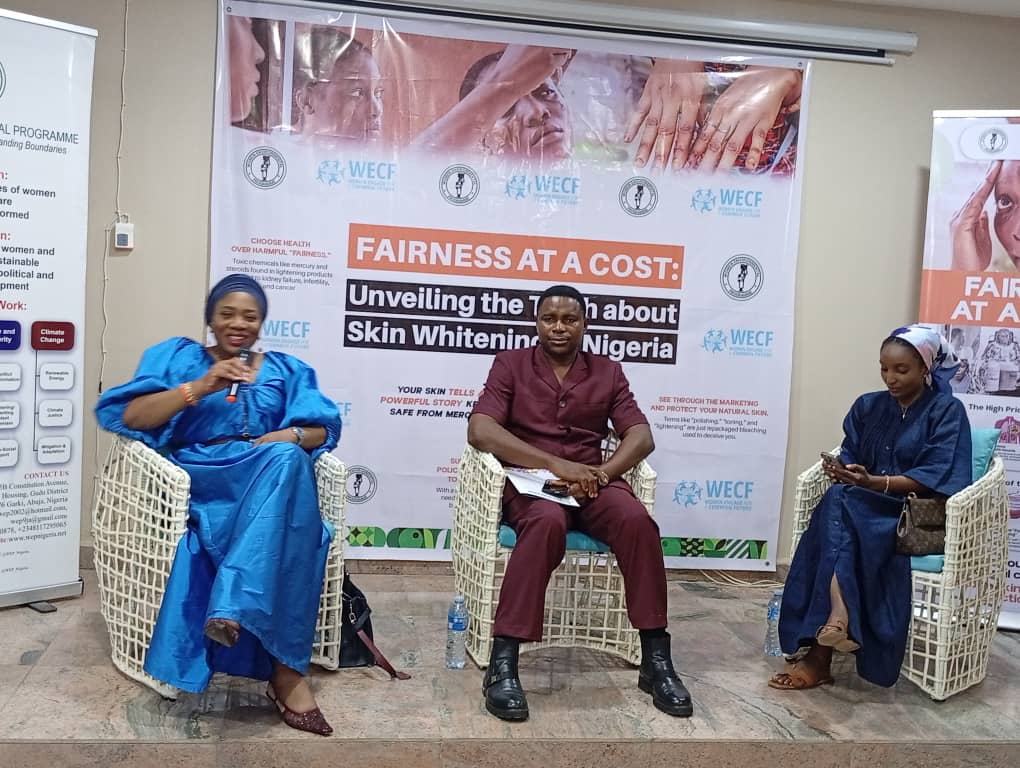
Dr. Fasawe reiterated that the skin serves as a vital protective barrier, and any practice that compromises it poses significant health risks.
In a remark, the Convener and Founder of the Women Environmental Programme (WEP), Dr. Priscilla Achakpa, who decried over the growing dangers associated with the use of skin whitening products, describing the trend as a major public health and environmental concern.
She explained that the initiative forms part of a nationwide awareness campaign to educate Nigerians on the risks linked to chemical-based skin lightening practices.
According to her, substances such as mercury, commonly found in many bleaching products, pose severe health threats.
She noted that exposure to these chemicals has been linked to life-threatening conditions including cancer, kidney failure, and liver cirrhosis.
Dr. Achakpa further emphasized that women are particularly vulnerable, as prolonged use of such products can damage the reproductive system.
” toxins absorbed through the skin can affect the uterus, leading to fertility challenges and complications in childbirth among women of reproductive age”
She cautioned that beyond individual health risks, the widespread use of harmful chemicals also has broader socio-economic and environmental implications.
“These include reduced agricultural productivity, contamination of water sources, and negative impacts on food safety, which in turn affect export potential”
The WEP founder added that chemicals washed off the skin often find their way into water bodies and farmlands, thereby posing risks to humans, animals, and the ecosystem at large.
Participants at the event called for intensified public sensitization and urged individuals to take responsibility by avoiding harmful products.
They stressed the need for collective action to address the growing menace and protect public health.
The event has its themed “Fairness as Cost: Unveiling the Truth about Skin Whitening in Nigeria.”
