…As Nigeria marks 66th Independence anniversary, subnational action initiative by Society for Planet and Prosperity emerges as barometer for climate accountability
By Danjuma Amodu
As Nigeria marks its 66th Independence anniversary, a new national ranking shows that the country’s next independence struggle, Climate Resilience will be won or lost at the subnational level.
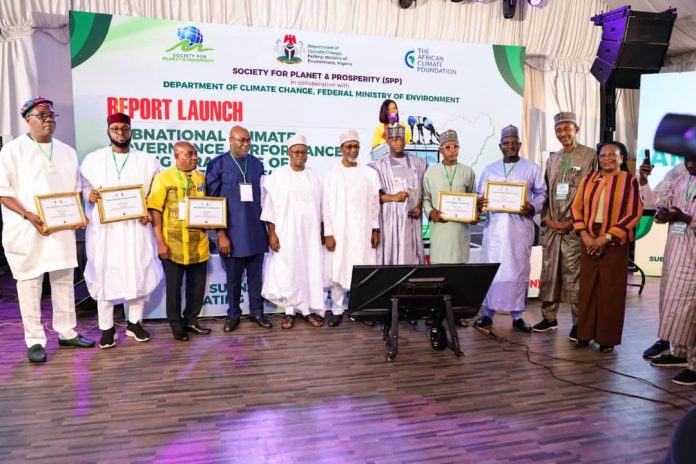
The 2026 Subnational Climate Governance Performance Rating and Ranking, conducted by the Society for Planet and Prosperity in collaboration with the Department of Climate Change, Federal Ministry of Environment, has rated Katsina State as the country’s top climate-performing state.
Katsina displaced Lagos in the third edition of the ranking. Abia came second, Kano third, while Lagos dropped to fourth and Kwara entered the top five in fifth position.
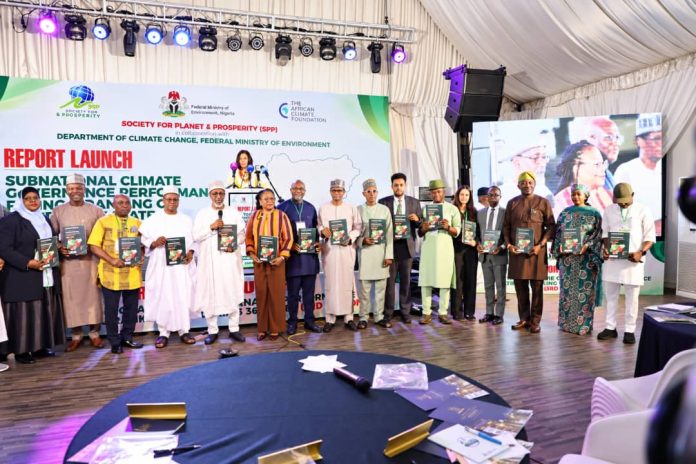
The ranking, launched in Abuja by the Society for Planet and Prosperity in collaboration with the Department of Climate Change, Federal Ministry of Environment, is now Nigeria’s most consistent barometer for how states govern and implement climate action.
A Ranking That Has Matured
What began in July 2024 as a diagnostic exercise has matured into a robust accountability tool.
The methodology has remained consistent but tightened each year. States are assessed across five pillars: climate institutions and governance; climate policy and action plans; climate project implementation and monitoring; climate budget and finance; and online visibility of climate activities.
Under the framework, states must submit evidence of five major climate projects, from which the three best are scored, alongside evidence on budgeting, access to climate finance, stakeholder participation, monitoring and evaluation.
“The ranking was based on evidence submitted by the states, followed by verification, with strict emphasis on transparency and integrity,” said SPP President, Prof. Chukwumerije Okereke, who noted that the assessment is not a measure of climate vulnerability but of governance effectiveness.
He stressed that when the ranking began, no state had issued a green bond and investment instrument, but by 2025, two states had done so and by 2026, four states had issued green bond investment instruments.
The evolution is deliberate. The first edition in 2024 asked: do states have climate policies and units? The second edition in October 2025 asked: are those policies backed by budgets and institutions? The third edition in 2026 asks: are budgets released, projects executed and results measurable in communities?
That progression explains why the Federal Ministry of Environment now describes the SCGPRR not as a scorecard but as a “strategic management and accountability tool.”
Three Years of Dramatic Shifts
The latest result marks a significant reshuffling since 2024.
In the inaugural ranking in July 2024, Lagos topped the chart, followed by Gombe and Ebonyi, while Borno and Ekiti shared fourth. Oyo, Kano and Zamfara were at the bottom; 34th, 35th and 36th respectively.
By the second edition in October 2025, Lagos retained first position with 315 points out of 365. Katsina made one of the most dramatic leaps from 25th in 2024 to second with 310 points. Kaduna moved from 16th to third, while Kano jumped from 35th to fourth, attributed to improvements in climate institutions, policy and implementation.
The third edition completes the reversal. Katsina, once 25th, is now first. Abia and Kano, previously outside the top three, are now second and third. Lagos, two-time leader, is now fourth, while Kwara broke into the top five.
For Katsina, the trajectory — 25th to 2nd to 1st in two years — has been described by SPP as one of the most significant improvements recorded under the initiative.
Why Subnational Now Defines National Climate Success
For the Federal Government, the ranking has become central to the delivery of Nigeria’s Nationally Determined Contributions.
Minister of Environment, Balarabe Abbas Lawal, said the Federal Government alone cannot deliver the country’s climate commitments when impacts — drought in the north, coastal flooding in Lagos, gully erosion in the South-east, and pressure on agriculture and water are felt most at state and community levels.
“Nigeria’s climate response cannot be delivered by the Federal Government alone. The success of our national commitments will ultimately depend on the strength of implementation at the subnational and community levels,” Lawal said.
“I encourage every state to establish a clear pathway from policy to budget, budget to projects, and projects to measurable results,” he added.
Under President Bola Tinubu’s Renewed Hope Agenda, Lawal said the Federal Government will continue to provide technical assistance and capacity development, urging states to make climate action integral to development and investment priorities and to use the ranking to “transform competition into constructive learning, rankings into accountability, and commitments into tangible outcomes.”
Director, Department of Climate Change, Dr Iniobong Abiola-Awe, echoed the call for political leadership, urging governors to prioritise climate in their development agendas and to translate commitments into implementable programmes.
The Oil, Gas and Private Sector Gap
What the ranking does not yet score — but what dominated conversations at the launch — is how states are engaging Nigeria’s most carbon-intensive sectors.
Nigeria remains Africa’s largest oil producer and is pursuing its Energy Transition Plan, which positions gas as a transition fuel while scaling renewables. Analysts argue that for subnational climate governance to be credible, oil-producing states and industrial hubs must align their development plans with low-carbon pathways.
The current top performers — Katsina, Abia and Kano — are not oil states, but their leadership shows climate governance is as much about adaptation, resilience and institutional readiness as it is about emissions.
Lagos, ranked fourth, offers a different model: integrating climate into mega-city planning, waste management and coastal resilience. The next frontier for SCGPRR, stakeholders say, is capturing private sector engagement — oil and gas operators, manufacturers, banking industry, agribusiness and whether states are leveraging carbon markets, green bonds and climate finance beyond public budgets.
Global Engagement Manager, Under2 Coalition at Climate Group, Yusuf Hassan, noted that Nigeria is now one of the strongest voices in the Under2 Coalition, with five member states including Cross River, Sokoto, Taraba and Lagos, and that almost every state improved between the first and second editions.
He pledged continued support, including financial grants, for states working to improve performance.
From Ranking to Results
Accepting the top position, Katsina State Commissioner for Environment and Special Adviser on Climate Change, Prof. Mohammed Alamin, said the state views climate action as both a development and security issue, linked to desertification, resource pressure and livelihoods.
He said the administration of Governor Dikko Radda has prioritised youth and women participation and is pursuing the Katsina One-Person-One-Tree programme, targeting two million trees in 2026 and 11 million by 2030, while positioning the state’s agriculture, renewable energy and carbon-market opportunities for international engagement.
Three editions in, the SCGPRR has achieved what many climate initiatives have not: consistency, national coverage and a shift from policy pronouncements to proof of delivery.
The challenge now, as Lawal noted, is whether states will treat the ranking not as a trophy but as a diagnostic for building a resilient, low-carbon and prosperous Nigeria where no state or community is left behind.
