
By Danjuma Amodu | February 11, 2027
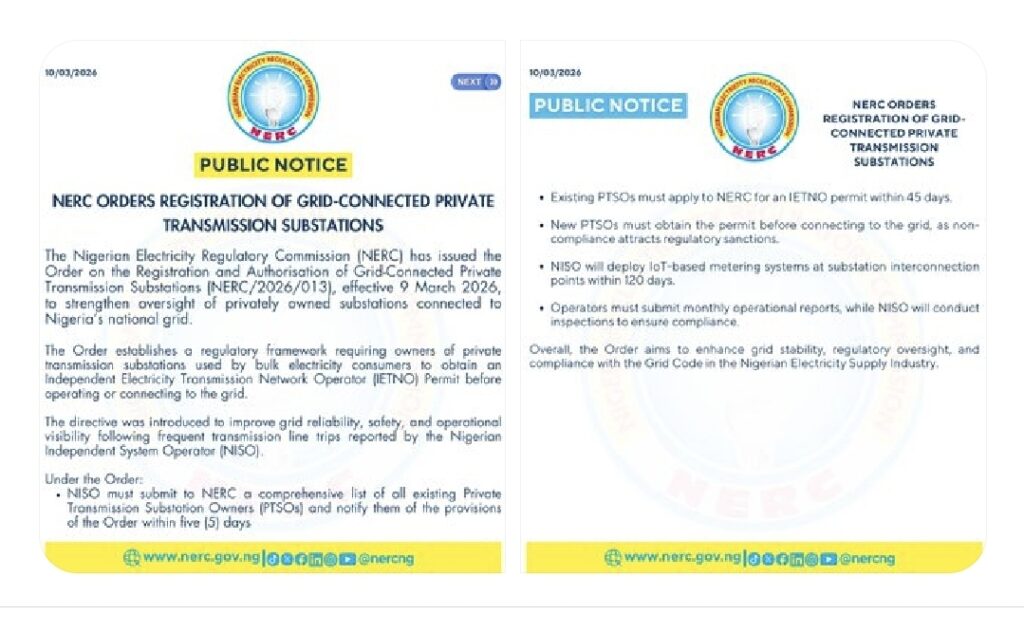
The Nigerian Electricity Regulatory Commission (NERC) has taken a significant step to strengthen the country’s electricity grid with the issuance of the Order on the Registration and Authorisation of Grid-Connected Private Transmission Substations.
The order, effective March 9, 2026, requires owners of private transmission substations used by bulk electricity consumers to obtain an Independent Electricity Transmission Network Operator (IETNO) Permit before operating or connecting to the grid.
This directive is aimed at improving grid reliability, safety, and operational visibility, following frequent transmission line trips reported by the Nigerian Independent System Operator (NISO). According to the order, NISO must submit a comprehensive list of all existing Private Transmission Substation Owners (PTSOs) to NERC and notify them of the provisions of the order within five days.
Existing PTSOs have 45 days to apply for an IETNO permit, while new PTSOs must obtain the permit before connecting to the grid. Non-compliance attracts regulatory sanctions. NISO will deploy IoT-based metering systems at substation interconnection points within 120 days, and operators must submit monthly operational reports.
The order is expected to enhance grid stability, regulatory oversight, and compliance with the Grid Code in the Nigerian Electricity Supply Industry. NISO will conduct inspections to ensure compliance, and the commission is committed to ensuring a reliable and efficient electricity supply in Nigeria.
The Nigerian Electricity Regulatory Commission (NERC) has emphasized that the registration and authorization process is crucial to ensuring the safe and efficient operation of private transmission substations connected to the national grid.
The commission’s order is also expected to promote transparency and accountability in the electricity sector, as operators will be required to submit regular reports and undergo inspections.
The Nigerian Independent System Operator (NISO) has been tasked with ensuring compliance with the order and taking enforcement action against non-compliant operators.
The commission has also urged all stakeholders, including private transmission substation owners, to comply with the order to avoid regulatory sanctions.
The move is seen as a significant step towards improving the overall performance of Nigeria’s electricity sector, which has been plagued by challenges including inadequate infrastructure and poor grid management. The commission’s efforts are expected to boost investor confidence and attract more investment into the sector.
The order is also expected to benefit electricity consumers, who will enjoy improved service delivery and reduced power outages. The commission has reiterated its commitment to ensuring that the electricity sector operates in a transparent and accountable manner and that the interests of consumers are protected.
The registration and authorization process is expected to be completed within the stipulated timeframe, and the commission will take enforcement action against any operator that fails to comply with the order.
