
By Hassan Hussain
The Secretary to the Government of the Federation, Senator George Akume, has underscored the importance of religious literacy as a critical tool for promoting national cohesion and sustainable peace in Nigeria.
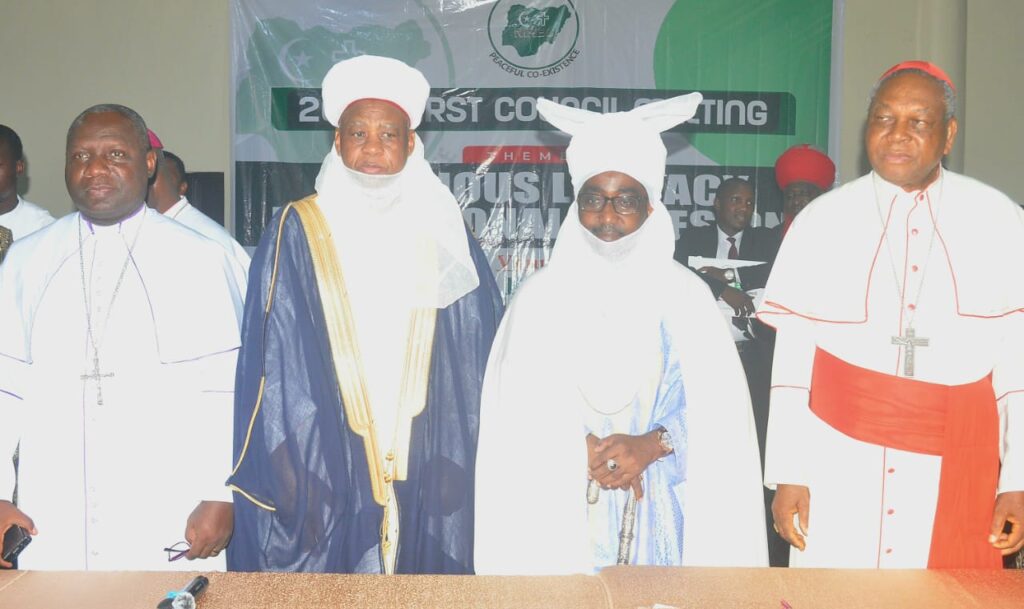
Akume made the remarks at the first triannual meeting of the Nigerian Inter-Religious Council, held in Abuja.
Speaking on the theme ‘Religious Literacy for National Cohesion’, the SGF said Nigeria’s socio-cultural diversity and religious vibrancy made it imperative to deepen citizens’ understanding of different faiths, their histories and practices, in order to foster mutual respect and peaceful coexistence.
He described religious literacy as a civic necessity that equips citizens with the capacity to resist manipulation, reject prejudice and engage differences with wisdom and restraint.
Akume commended NIREC for providing a platform for dialogue and interaction among religious groups, noting that the council remains vital to laying the foundation for enduring peace and harmony across the country.
He stressed that national cohesion cannot be built on suspicion or exclusion, but on justice, dignity and mutual respect, where every citizen feels valued.
The SGF observed that contemporary challenges such as insecurity, misinformation, stereotypes and identity-based divisions continue to threaten peace, and added that religion, when misused, can become a trigger for conflict.
He maintained, however, that proper religious understanding can counter such threats and promote unity.
On the role of government, Akume said efforts must focus on strengthening citizenship, improving the quality of education and promoting tolerance, rather than politicising religion.
He emphasised the need for improved teacher training, better learning materials and classroom environments that encourage empathy and responsible citizenship.
The SGF also highlighted concerns raised by UNICEF over attacks on schools and disruptions to learning, noting that safe and secure educational environments are essential for effective teaching and learning.
He called on traditional and religious leaders to complement formal education by promoting sound religious teaching at community level.
Akume further drew attention to the growing influence of the information space, referencing Nigeria’s collaboration with UNESCO in establishing the International Media and Information Literacy Institute to combat misinformation and promote responsible communication.
He urged stakeholders — including schools, faith-based organisations, media institutions and public servants — to work collaboratively in raising a generation of Nigerians who embrace tolerance, patriotism and peaceful coexistence.
Addressing religious leaders, the SGF described their role as pivotal in shaping values, resolving conflicts and promoting truth, and cautioned against the use of religion to justify violence or division.
On the forthcoming 2027 general election, Akume called on NIREC and its partners to intensify grassroots mobilisation and promote peaceful participation, while guarding against manipulation and ensuring the protection of lives and property.
He assured that the Federal Government would continue to support religious and traditional institutions to maintain peace before, during and after the elections.
The SGF concluded by urging participants to prioritise religious and media literacy as essential components of nation-building, institutional trust and long-term stability.
The Sultan of Sokoto, Alhaji Sa’ad Abubakar III, called for greater understanding, trust and sustained dialogue among Nigerians of different faiths as a pathway to peaceful coexistence.
He said understanding one another would enable citizens to work together positively, noting that dialogue remains the most effective tool for addressing differences.
The Sultan, who also serves as Co-President of Religions for Peace, said Nigeria’s commitment to interfaith dialogue aligns with global efforts to promote peace.
He disclosed that such engagements extend beyond the country, citing recent meetings in London and forthcoming discussions in Mauritius aimed at strengthening cooperation among religious leaders worldwide.
The monarch emphasised that Nigerians must not ignore their differences, but seek to understand them in order to foster unity.
He rejected claims that any religious group was planning to dominate or eliminate another, stating categorically that Muslims are not in any position to remove Christianity from Nigeria.
According to him, incidents of violence in parts of the country should not be attributed to religion, but to criminality.
The Sultan noted that many victims of terrorism and banditry are Muslims, adding that perpetrators of such acts should not be identified along religious lines.
He cautioned against the misuse of religious titles, observing that knowledge of language alone does not confer authority in religious matters.
The Sultan also underscored the need for trust among religious leaders and citizens, saying it is essential for national progress.
He urged members of the council to remain steadfast in promoting peace, assuring that continued dialogue would strengthen unity and national cohesion.
In his remarks, the President of the Christian Association of Nigeria, CAN, Archbishop Daniel Okoh, described religious literacy as essential for national cohesion in a diverse country such as Nigeria.
Okoh said Nigeria’s ethnic, cultural and religious diversity should be seen as a source of strength rather than division.
‘Religious literacy is not merely the academic understanding of doctrines or rituals. It is the cultivation of awareness, sensitivity and respect for the beliefs and practices of others,’ he said.
According to him, misunderstanding and manipulation of religion often fuel division, conflict and mistrust.
He noted that NIREC has, over the years, served as an important platform for dialogue, conflict resolution and mutual understanding between Christians and Muslims.
‘Through NIREC, we have demonstrated that despite our religious differences, we share common values of peace, justice, the dignity of human life and the well-being of our nation,’ he said.
Okoh stressed the need to mainstream religious literacy into schools, public discourse and community engagements to counter misinformation, hate speech and divisive rhetoric.
‘Our places of worship must become centres of enlightenment, where messages of peace, unity and responsible citizenship are consistently emphasised,’ he added.
He also called for stronger collaboration among faith communities, civil society groups and the media to promote peaceful coexistence and national unity.
The CAN president reaffirmed the commitment of the Christian body to working with Muslims and other stakeholders to build a nation where all citizens feel safe, valued and respected regardless of faith.
The NIREC meeting, held under the theme ‘Religious Literacy for National Cohesion’, brought together Christian and Muslim leaders, government officials, civil society organisations and development partners to discuss strategies for strengthening interfaith understanding and peace in Nigeria.
