
By Danjuma Amodu
Nigeria must move beyond treating climate change as an environmental challenge and begin converting its climate financing needs into green jobs, investment opportunities and sustainable economic growth, stakeholders at the Climate Change and Circular Economy Africa 2026 conference have said.
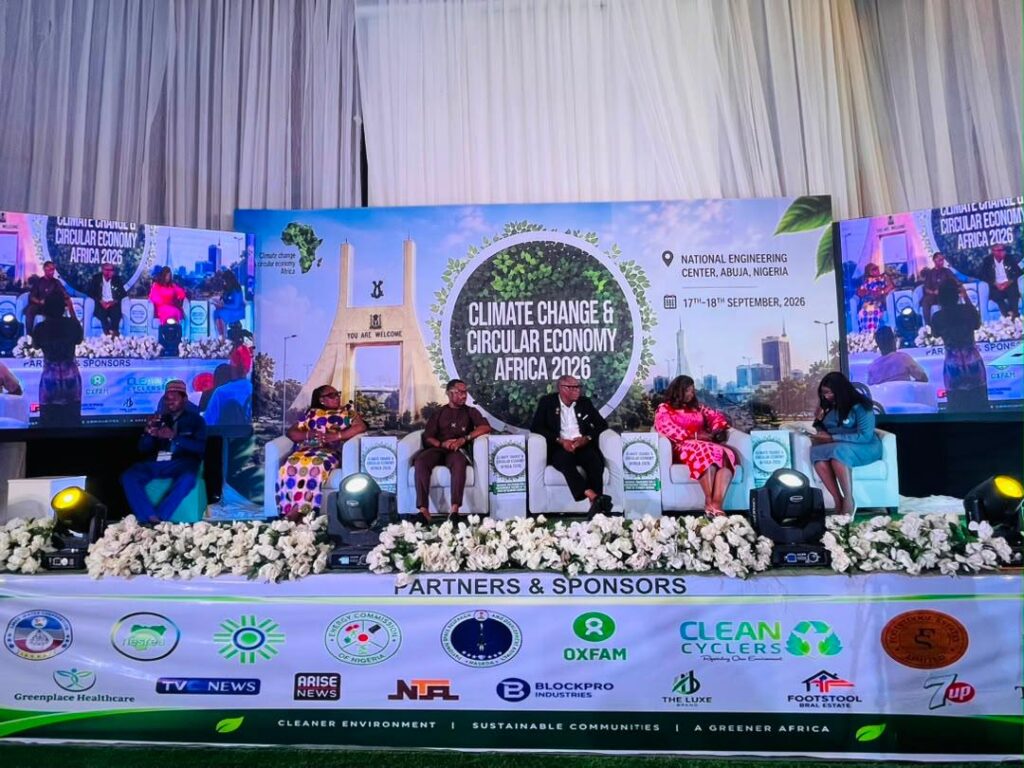
The call was made on Thursday at the National Engineering Centre, Abuja, where participants urged the Federal Government to strengthen policies, attract private capital and develop locally driven solutions to the country’s growing climate and waste management challenges.

The conference, themed “Pioneering Natural Solutions for a Sustainable Future,” brought together policymakers and stakeholders who said Nigeria could not afford to remain on the margins of the global transition to a low-carbon and circular economy.
Chief Host of the event, Senator Ireti Kingibe, represented by her Executive Secretary, Becky Ephraim, said applying circular economy principles to agriculture, manufacturing, construction and urban planning could unlock an estimated $15 billion market opportunity and create hundreds of thousands of sustainable jobs.
“We cannot afford to sit at the periphery of the global green transition,” Kingibe said.
She said the National Assembly was advocating policies to promote extended producer responsibility, tax incentives for green technology enterprises, integrated waste management and gender-responsive climate financing.
Kingibe’s position reflects growing pressure on Nigeria to translate its climate commitments into practical economic opportunities, particularly as the country faces rising waste generation, environmental degradation, energy challenges and the need for more resilient infrastructure.
Minister of Environment, Balarabe Lawal, represented by Ohis Ambiose, said climate change had moved beyond an environmental concern to become a political, economic and social issue.
“Climate change has long gone beyond being perceived as merely an environmental issue, but has been scientifically proven and understood as a political, economic and social issue,” he said.
Lawal said the circular economy offered a framework for addressing climate change while promoting economic growth, job creation and environmental sustainability.
He called for greater investment in renewable energy, sustainable agriculture, recycling, green buildings, sustainable transportation and climate-resilient water management.
The Convener of the conference, Zigwai Fanda, said Nigeria must begin to treat waste as an economic resource capable of supporting new industries, businesses and jobs.
“The circular economy is not simply about recycling. It is about redesigning the way our economy works,” Fanda said.

He said Nigeria’s estimated $237 billion climate financing requirement between 2026 and 2030 should not be viewed only as a funding challenge, but also as an opportunity for innovation, investment, entrepreneurship and economic transformation.
Fanda urged young Nigerians to develop local green technologies and businesses rather than depend solely on imported solutions, stressing that domestic innovation would be critical to building an affordable and sustainable transition.
On the built environment, Deputy Director, Grace Bitrus, representing the Minister of Housing and Urban Development, said the ministry was reviewing the National Building Code to strengthen standards, improve energy and resource efficiency and make buildings more resilient to emerging climate risks.
“This review provides an opportunity to strengthen our building standards, to respond to emerging climate risks, improve energy and resource efficiency, enhance building performance and support safer, healthier and more resilient communities,” she said.
Bitrus said Nigeria could not address its housing deficit by simply constructing more buildings, insisting that new housing must be safer, energy-efficient and climate-resilient.
“We cannot meet Nigeria’s housing needs simply by constructing more buildings. We must construct better, safer, energy-efficient, climate-resilient buildings,” she said.
She added that the ministry was promoting local building materials and manufacturing hubs across the six geopolitical zones to boost domestic production, create jobs and develop resilient local value chains.
“Construction and demolition materials should increasingly be viewed as resources that can be recovered, reused and recycled,” Bitrus said.
The Director-General and Chief Executive Officer of the National Council on Climate Change, Omotenioye Majekodunmi, represented by Chinwe Oluwatoyin-Adindu, said Nigeria must move from developing climate policies to implementing them through investments, infrastructure, jobs and measurable outcomes.
“The task now is not to produce more strategies. It is to make these instruments function as one implementation architecture rather than a set of parallel documents,” she said.
Majekodunmi called for stronger financial structures capable of attracting private capital into climate projects, identifying bankable projects, affordable financing, reliable data and effective risk-sharing mechanisms as essential to unlocking investment.
She also urged African countries to develop climate solutions that reflect their own economic realities.
“Africa will not succeed importing transition models built for different economies. We need African-led pathways, affordable capital, stronger domestic institutions and investable pipelines,” she said.
