
By Danjuma Amodu
A seven-point roadmap for economic, infrastructural and social transformation of the North Central has been adopted at the first North Central Stakeholders Development Summit in Abuja, with the North Central Development Commission, NCDC, also signing strategic MoUs with NIRSAL and SMEDAN to drive agriculture and enterprise growth.
The roadmap, contained in a communiqué read by the Executive Director, Finance and Chairman of the Technical Committee, Prof. Muhammad Bashar Nuhu, is anchored on economic development, infrastructure, social development, security, climate and environment, digital economy, and sustainable financing and institutional delivery.
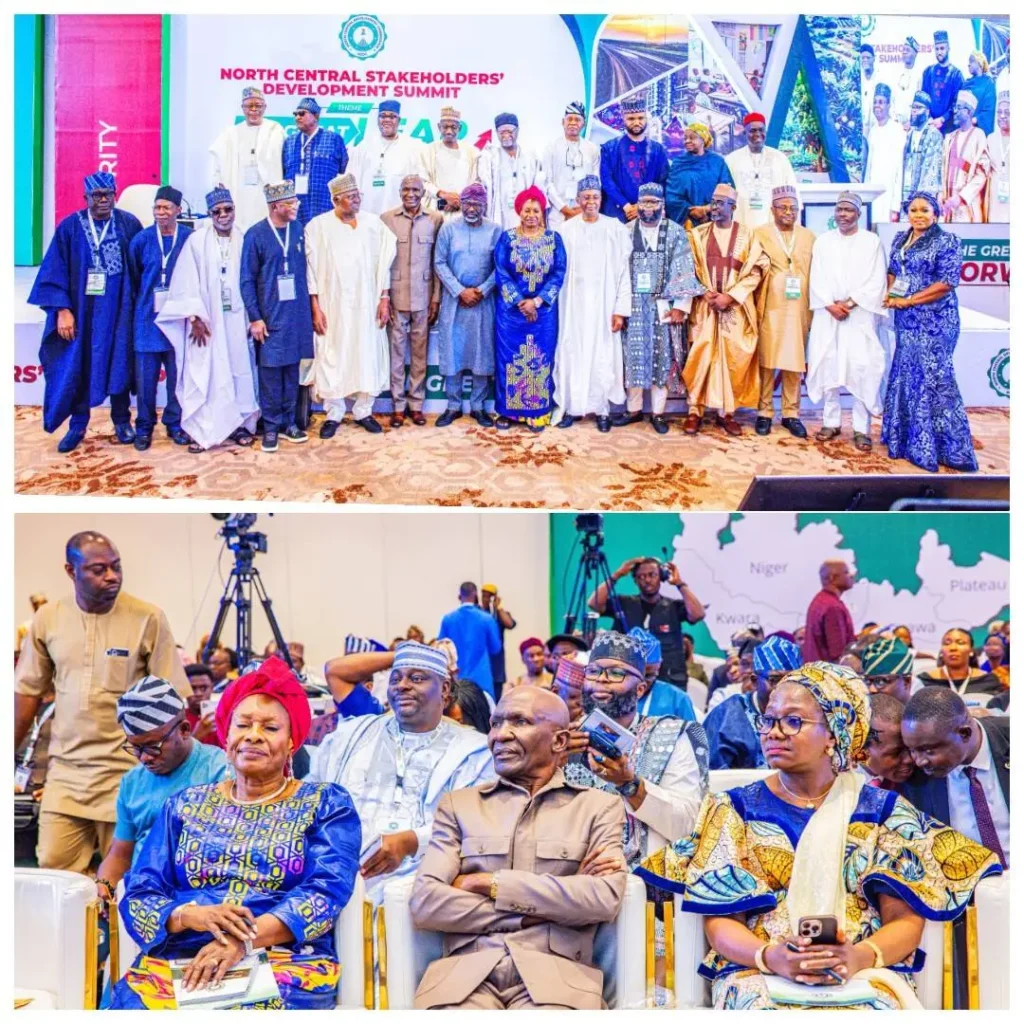
The Summit, themed “The Great Leap Forward: A 20-Year Economic, Infrastructural and Social Development Plan for the North Central Region,” observed that despite vast agricultural land, water, mineral and energy resources, human capital and strategic location, the region’s assets have not translated into productivity, incomes and improved living standards.
To reverse the trend, participants tasked NCDC with developing a GIS-enabled regional economic database and a state-by-state mapping of comparative advantages, productive assets, farms, water bodies, minerals, infrastructure gaps and investment opportunities.
The economic blueprint also proposes state-specific agricultural and livestock value chains covering inputs, mechanisation, irrigation, farmer capacity, storage, processing, packaging, branding, logistics and exports, sequenced into bankable quick wins.
For infrastructure, the Summit recommended an integrated programme linking the six states and the FCT through strategic roads, rail, inland waterways and logistics systems, prioritising corridors that unlock agricultural production and markets, including urgent attention to the Abuja–Lokoja Road.
It further called for feasibility assessment of regional rail, Baro inland-port logistics, dry-port connections and modern freight systems.
On human capital, the Summit advocated a disaggregated social-inclusion data system covering children, youth, women, persons with disabilities, indigent households and rural communities, alongside a safe and inclusive education framework to cut dropout rates, address teacher shortages and improve learning quality and access.
Security, identified as a major constraint to development, will require a coordinated regional security and peacebuilding framework to support statutory security agencies through intelligence sharing, community engagement, early warning and inter-state coordination, including lawful deployment of satellite imagery, drones and geospatial tools.
To address climate risks, participants proposed a North Central Climate and Disaster Resilience Programme beginning with geo-referenced mapping of flood, erosion, drought and mining hazards, community risk profiles and early-warning systems, backed by desilting, drainage clearing, erosion control and enforcement against unsafe development along flood corridors.
In the digital economy, the communiqué urged NCDC to expand broadband and affordable digital access across states, local governments, wards and rural communities, and to establish AI, digital-skills and teacher-training centres starting with computer-enabled facilities in primary schools.
Noting that public funding alone cannot deliver the 20-Year Plan, the Summit recommended a blended financing model — private capital for commercially viable projects, blended finance for projects with high economic benefits but weak initial returns, and public funding for essential non-commercial services.
It also called for legal and institutional backing for the Plan to survive electoral cycles, the creation of a Programme Management Office within NCDC to coordinate flagship programmes and performance reporting, and clear assignment of responsibilities among NCDC, Mandate States, FCT, federal institutions, local governments, traditional institutions, private sector and development partners.
In a major highlight, NCDC signed MoUs with the Nigeria Incentive-Based Risk Sharing System for Agricultural Lending, NIRSAL, and the Small and Medium Enterprises Development Agency of Nigeria, SMEDAN, after months of engagements, to unlock the region’s food production potential and strengthen entrepreneurship.
NCDC Managing Director, Dr. Cyril Yiltsen Tsenyil, NIRSAL Executive Director, Ewaen Imohe, and SMEDAN Director-General, Charles Odii, pledged joint action to make the region more productive and economically viable.
Chairman of the NCDC Governing Board, Barr. Cosmas Akighir, and Permanent Secretary, Ministry of Regional Development, Dr. Mary Ogbe, pledged oversight and support for the partnerships.
Closing the Summit, Dr. Tsenyil thanked participants for their patriotic contributions, while Chairman of the Central Steering Committee, Alh. Suleiman Baba Ali, commended stakeholders, President Bola Ahmed Tinubu and committee members for delivering a successful Summit.
