
New partnership to link researchers with investors and use media advocacy to turn academic findings into jobs and revenue
By Danjuma AMODU
The National Office for Technology Acquisition and Promotion (NOTAP), in partnership with the Nigeria Union of Journalists (NUJ), FCT Council, has agreed to commercialise academic research findings as part of efforts to boost Nigeria’s revenue and accelerate industrial growth.
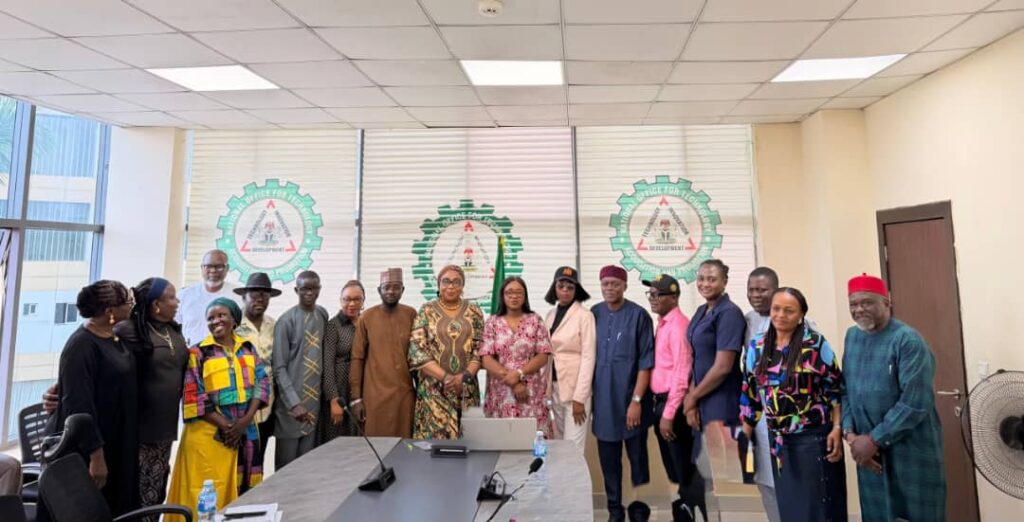
The Director-General of NOTAP, Dr. Obiageli Amadiobi, disclosed this on Monday during a courtesy visit by the Grace Ike-led leadership of NUJ FCT Council to the agency’s headquarters in Abuja.
Dr. Amadiobi said the collaboration will focus on promoting indigenous innovation, technology transfer, intellectual property awareness, and strategic matchmaking between researchers and investors.
She announced that NOTAP will host a National Technology and Innovation Summit at the Civic Centre, Lagos, on October 7 and 8, 2026. According to her, the summit will bring together innovators, researchers, manufacturers, financial institutions, investors and the Bank of Industry to facilitate the commercialisation of research outputs.
“The event will provide a platform for researchers to connect with investors and industry players through strategic matchmaking, enabling innovative ideas and technologies developed in Nigerian institutions to attract funding, reach the market and contribute to national economic growth.”
She noted that the initiative aligns with NOTAP’s mandate of promoting technology acquisition and ensuring research findings are translated into commercially viable products and services capable of creating jobs and increasing national revenue.
The NOTAP boss stressed the critical role of the media in shaping public understanding of science and technology.
“Journalists play a critical role in shaping public understanding of science, technology and innovation. Effective reporting will accelerate Nigeria’s technological advancement.”
On technology domestication, Dr. Amadiobi said one of NOTAP’s core mandates is adapting foreign technologies to meet Nigeria’s needs. She lamented that Nigeria had for years served as a dumping ground for foreign technologies due to inadequate local capacity.
She, however, noted that NOTAP’s Local Vendor Policy has changed the narrative, particularly in ICT, by compelling Original Equipment Manufacturers to train Nigerians.
“The policy has led to the emergence of indigenous software developers and ICT professionals who are making remarkable contributions both within and outside the country.”
She added that the agency plans to replicate the ICT success in manufacturing, engineering and other sectors through technology transfer and skills development.
Dr. Amadiobi also disclosed plans to establish a technology and innovation hub for practical demonstrations of emerging technologies, including Artificial Intelligence. NOTAP is partnering with Huawei, MTN and Airtel to build staff capacity and strengthen Nigeria’s ability to evaluate imported technologies.
On youth empowerment, she unveiled the National Outsourcing Value Acceleration (NOVA) Programme, designed to equip young Nigerians with industry-relevant skills through simulation-based training before field experience in maritime, engineering and manufacturing.
“The initiative will help bridge Nigeria’s skills gap while positioning young Nigerians for global employment opportunities.”
She said several state governments, including Niger State, have indicated interest in partnering with NOTAP to establish similar innovation centres.
In her remarks, Chairman of NUJ FCT Council, Comrade Grace Ike, described NOTAP as strategic to Nigeria’s economic growth.
“I believe the future of Nigeria depends on strong partnerships between institutions that inform, innovate and inspire. NOTAP stands at the very heart of Nigeria’s technological progress. Your work is not only important but strategic.”
Comrade Ike said the media has a responsibility to explain, amplify and connect innovation with the people. She proposed regular capacity-building for journalists covering science and technology, and joint sensitisation campaigns on intellectual property rights, patents and technology transfer for researchers, startups and inventors.
“As journalists, we recognise that technology and communication are inseparable. The media has a responsibility not only to report innovation but to explain it, amplify it and connect it with the people.”
Both parties agreed to work together on public enlightenment, innovation advocacy and capacity building to drive national development.
