
By Danjuma Amodu
The Presidential Enabling Business Environment Council, PEBEC, has unveiled plans to integrate the digital platforms of federal Ministries, Departments and Agencies, MDAs, to eliminate duplication, cut regulatory bottlenecks and deliver a seamless experience for businesses.
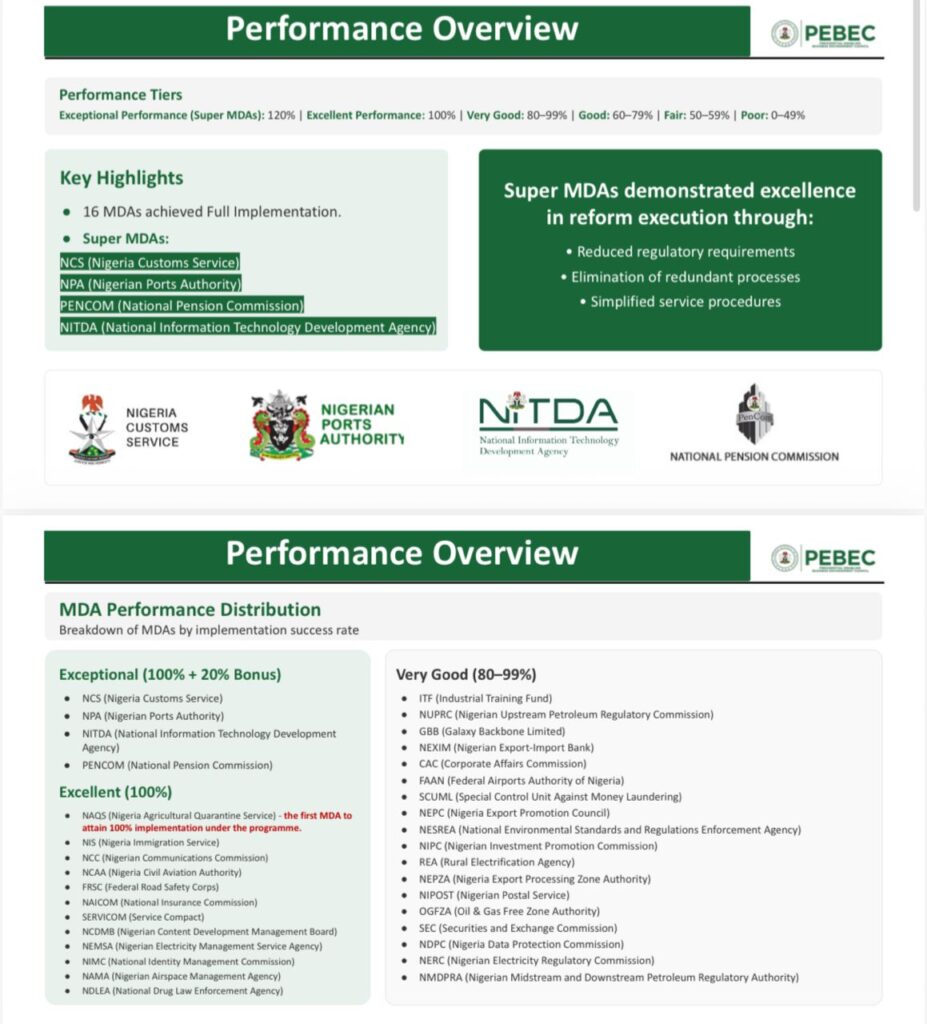
The move follows significant gains recorded under its public sector reform programme, with 98 per cent of the 69 MDAs monitored now meeting prescribed responsiveness standards.
Director-General of PEBEC, Zahrah Mustapha Audu, disclosed this during an interaction with journalists in Abuja on Friday.
She said the council’s next phase of reforms will focus on connecting government agencies digitally to enable secure information sharing and faster service delivery, instead of allowing them to operate in silos.
According to her, although many agencies have digitised their operations, businesses still face unnecessary delays because they are repeatedly required to submit the same information to different regulators.
She cited the National Identification Number, NIN, as an example, noting that agencies should no longer demand documents containing information already available on government databases.
“Our objective is to create an environment where businesses provide information once, and relevant government agencies can securely access it instead of making investors repeat the same process multiple times,” she said.
Audu explained that the reforms align with PEBEC’s broader mandate to eliminate bureaucratic obstacles, simplify regulatory processes and position Nigeria as a preferred investment destination.
Rather than adopting a confrontational approach, she said the council works collaboratively with government institutions to resolve operational challenges.
“PEBEC is not a name-and-shame organisation. We identify gaps and provide technical support to help agencies improve their services,” she said.
REFORM GAINS
She revealed that the council recently concluded a 90-day Business Environment Enhancement Accelerator Programme, during which reform champions embedded across 69 MDAs worked with PEBEC to strengthen compliance with the Business Facilitation Act.
The initiative, she said, resulted in 98 per cent of the agencies meeting service delivery timelines and responding promptly to enquiries from businesses and members of the public.
Audu noted that the council is now shifting focus from basic compliance to competitiveness, with the goal of making Nigeria a more business-friendly destination than neighbouring economies such as Ghana, Benin Republic and Kenya, before benchmarking against leading global performers.
As part of efforts to simplify business regulation, she said PEBEC reviewed licensing procedures and documentation requirements across several agencies to eliminate obsolete and repetitive processes that increase the cost and time of doing business.
TOP PERFORMERS
She commended the Nigeria Customs Service for fully complying with reform requirements while reducing cargo clearance timelines and simplifying import and export procedures.
Other agencies recognised for exceeding compliance expectations include the Nigerian Ports Authority, the National Information Technology Development Agency and the National Pension Commission, all of which introduced additional customer-focused reforms beyond the minimum standards.
Audu stressed that the assessment was not intended to rank agencies but to institutionalise reforms that improve the experience of businesses dealing with government institutions.
She warned that inefficiency in a single government office can undermine investor confidence in the entire country.
“If someone has a bad experience with one government agency, they do not separate that agency from the government. They simply conclude that Nigeria is not working,” she said.
NEXT STEPS
To sustain the gains, Audu disclosed that PEBEC will continue its quarterly mystery-shopping exercise, under which officials anonymously access government services to independently assess service quality from the perspective of ordinary users.
She added that the council also operates live performance trackers that allow agencies and the public to monitor compliance levels and identify areas requiring improvement.
According to her, the 2026 Business Facilitation Act Compliance Report is expected to be released in November after the completion of the annual assessment.
She said PEBEC’s long-term goal is to entrench a public service culture built on transparency, efficiency and accountability, while creating a fully integrated digital government that makes regulatory compliance faster, easier and more predictable for businesses and investors.
