
…Prof. Oja Paul Egwemi unveils PIDSI model to tackle polycrisis through participatory knowledge, interdisciplinary collaboration and community ownership
By Ruth Ojimaojo Daniel
A Professor of Dramatic Literature and Film Studies at Prince Abubakar Audu University, Anyigba, Prof. Oja Paul Egwemi, has called for a stronger connection between university research and community development.
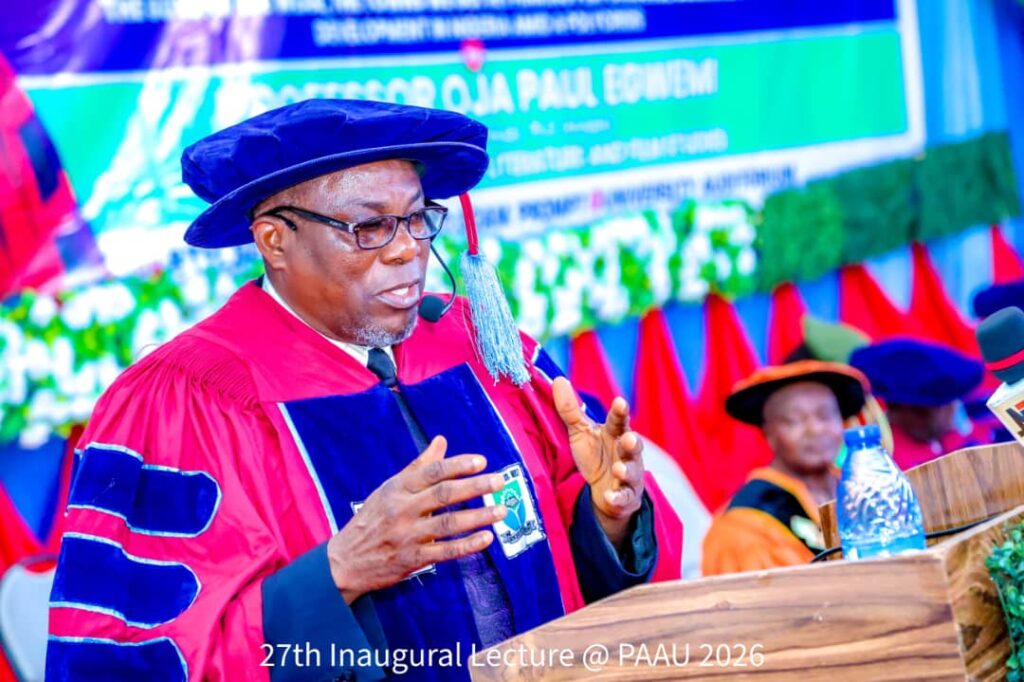
Egwemi made the call while delivering the 27th Inaugural Lecture of the university on Tuesday, September 8, 2026, at the University Auditorium, where he emphasised the need to take academic research beyond the classroom to address pressing challenges confronting host communities.
He said communities were facing complex challenges ranging from economic hardship to environmental and health concerns, making the need for practical and sustainable solutions increasingly urgent.
The inaugural lecturer noted that the evolving nature of global and local challenges had made conventional approaches to Theatre for Development, TfD, difficult, particularly in the face of what he described as a “polycrisis” — a nexus of interconnected social, economic, governance and environmental issues.
He observed that such complex societal problems cannot be resolved through isolated academic efforts, explaining that they require interdisciplinary collaboration among experts across various fields working directly alongside community members.
To bridge the gap, Prof. Egwemi presented the PIDSI model, a strategic framework centred on five core areas: Participatory Knowledge Production, Interdisciplinary Collaboration, Digital and Community Communication, Sustainability Through Community Ownership, and Impact Evaluation with Reflective Learning.
He explained that the approach encourages community members to actively participate in research as co-creators of knowledge, while professionals from different disciplines work together to develop solutions to societal problems.
Prof. Egwemi further highlighted that the model promotes the integration of digital communication alongside live theatre performances to create wider public awareness on critical issues affecting community health and general wellbeing.
He stressed the importance of assessing the lasting effects of development projects, arguing that success must be evaluated by long-term community impact rather than merely measuring audience reach or numbers.
He concluded with a challenge to academics and researchers to examine how their teaching and research contribute to national development, urging universities to turn theoretical knowledge into meaningful action within society.
