
By Danjuma Amodu
The First Lady, Senator Oluremi Tinubu, has said President Bola Tinubu deserves a second term, noting that the administration’s economic reforms are beginning to produce tangible results.
She spoke on Monday in Abuja at the inauguration of the All Progressives Congress (APC) Presidential Women Campaign Council for the 2027 general elections.
Mrs Tinubu said the government’s economic interventions had moved beyond policy pronouncements to measurable signs of national stabilisation.
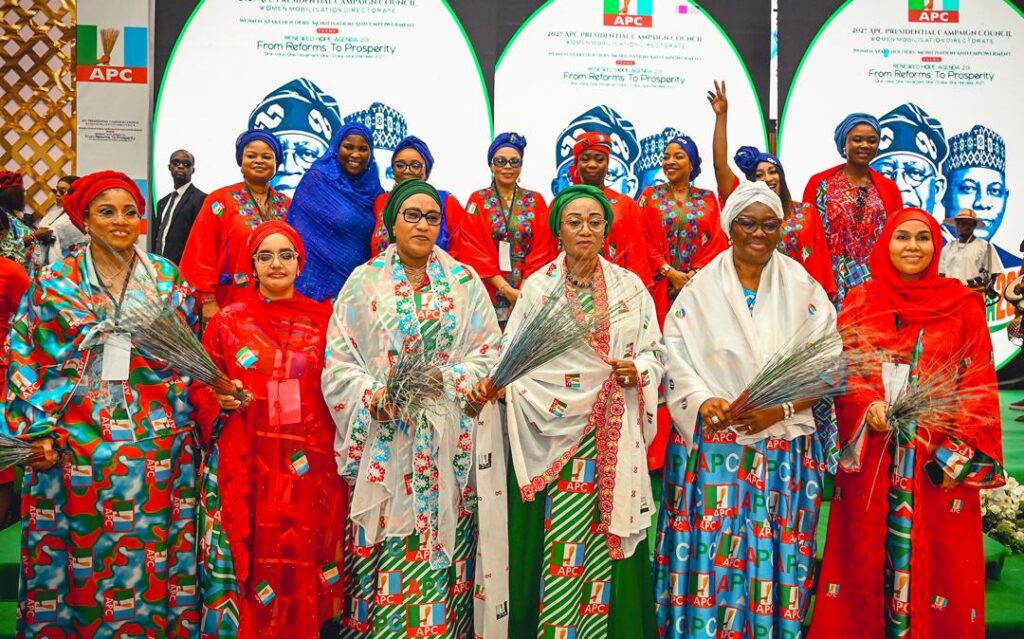
Front row (L-R): First Lady Sen. Oluremi Tinubu, wife of the Vice President Hajiya Nana Shettima, flanked by wife of the Deputy Speaker Mrs Benjamin Kalu, wife of the Speaker Mrs Tajudeen Abbas, wife of the Senate President Mrs Akpabio and wife of the Deputy Senate President Mrs Barau.
Back row (L-R): Executives of the PCC Women Campaign Council Mrs Adejoke Orelope-Adefulire, Hajiya Zainab Ibrahim, Minister of Women Affairs Imaan Sulaiman-Ibrahim, APC National Women Leader and PCC Women Campaign Director Dr Mary Alile-Idele, Chairman of NIDCOM Hon. Abike Dabiri-Erewa and Barr. Betta Edu during the inauguration of the APC PCC Women Campaign Council by the First Lady in Abuja on Monday.
She urged APC women across the country to take the message of the administration’s achievements to the grassroots and mobilise Nigerians for total victory for President Tinubu and all APC candidates in 2027.
The campaign council, inaugurated under the banner “Renewed Hope Agenda 2.0: From Reforms to Prosperity,” is expected to spearhead a nationwide women-led mobilisation drive covering the presidency, governorships, the National Assembly and State Houses of Assembly.
“Our economy is stabilizing, inflation is coming down, foreign reserves are growing, and investors are returning to Nigeria,” she said.
She also cited the Nigeria Education Loan Fund (NELFUND) initiative, noting that university students could now access interest-free loans to support their education.
According to her, the progress recorded by the administration was not merely political rhetoric but evidence that the country was moving towards economic recovery and prosperity.
“The theme of this year’s rally is not just a slogan; it is our reality,” the First Lady declared.
Describing President Tinubu as a courageous leader prepared to take difficult decisions in the national interest, she charged members of the newly inaugurated council to move across the country, engage communities and convince voters to support the APC at every level.
Mrs Tinubu also announced a major restructuring of the various women support groups campaigning for the President, saying they had been brought under a single APC campaign structure to ensure unity and discipline.
“We have collapsed every other women support group into one — from Tinubu Again to Torch Bearers and others. What you will see on the ballot box is APC. We are here to promote APC, nothing less,” she said.
She said the campaign structure would organise six geopolitical zonal mega-rallies, state-level rallies and a grand finale in Abuja ahead of the 2027 polls.
She disclosed that she would participate in the zonal campaigns alongside the wife of the Vice President, Hajia Nana Shettima, and other senior party leaders.
At the state level, she said the mobilisation would be driven by the wife of the Senate President, the wife of the Speaker of the House of Representatives and the Chairperson of the Nigeria Governors’ Spouses Forum.
Earlier, the APC National Women Leader, Dr Mary Alile Idele, charged the newly inaugurated campaign council to translate the administration’s reform message into direct grassroots engagement.
She said the “Renewed Hope Agenda 2.0: From Reforms to Prosperity” was not simply a campaign slogan but a call for women leaders to take ownership of the administration’s message and communicate its opportunities and achievements to Nigerians.
Alile urged the women to take the campaign into homes, markets, communities and wards, insisting that grassroots mobilisation would be critical to the party’s success in 2027.
She outlined a four-point strategy for the council, beginning with the creation of stronger women-to-women networks across wards, local government areas and communities.

The second, she said, was to identify women in need, link them with available empowerment opportunities and ensure that beneficiaries subsequently became agents of development within their communities.
She also tasked the council with taking the message of reform, opportunity and prosperity to every community while listening to citizens’ concerns and transmitting constructive feedback to the leadership.
The final plank of the strategy, she said, was to move beyond mobilisation to measurable results through clearly defined responsibilities, functional grassroots structures, regular engagement and accountability.
