
By Danjuma Amodu | April 26, 2026
Nigeria’s opposition political leaders have resolved to field a single presidential candidate in 2027 and resist what they described as attempts by the ruling All Progressives Congress (APC) to entrench a one-party state.
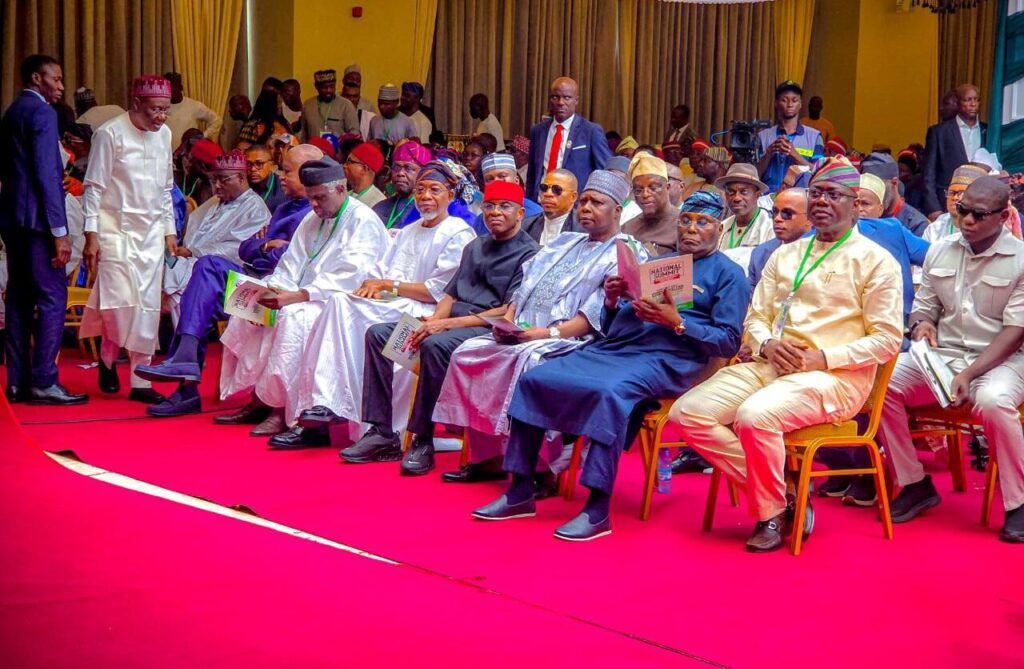
The decision was reached Saturday at the Opposition Political Parties National Summit held at the International Conference Centre, University of Ibadan. The summit was billed to be chaired by former President Olusegun Obasanjo, who was unavoidably absent. Co-chairmen of the organising committee, former Information Minister Prof. Jerry Gana and Dr. Kashim Ibrahim Imam, steered proceedings.
Heavyweights converge
The closed-door meeting drew a broad coalition of opposition figures under tight security across key areas of Ibadan. Former Vice-President Atiku Abubakar arrived to join former Minister of Transportation Rotimi Amaechi, former Kano Governor Rabiu Musa Kwankwaso, and ex-Osun Governor Rauf Aregbesola. Also in attendance were Labour Party’s 2023 presidential candidate Peter Obi, ADC National Chairman and former Senate President David Mark, political strategist Prof. Pat Utomi, PDP factional chairman Saminu Turaki, former governors Aminu Tambuwal, Olagunsoye Oyinlola, Babangida Aliyu, and Abdulfatai Ahmed, former SGF Yayale Ahmed, and activist Aisha Yesufu.
Analysts described the gathering as an early but significant step toward a coordinated opposition front ahead of the 2027 polls.
A mission to rescue Nigeria
Addressing the summit, Senator David Mark called the meeting “an urgent response to our nation’s call to patriotic duty” at a critical moment in Nigeria’s history.
“My prayer is that history will remember us, that when the nation cried out to be rescued, we answered. When children went to bed hungry, we answered. When proud, hardworking citizens were turned to beggars, we answered,” Mark said.
He warned that insecurity had become “a defining feature of daily life,” noting that Nigeria recorded more than 12,000 conflict-related deaths in 2025 and now ranks 4th on the global terrorism index, with at least 15 Nigerians killed and about 19 abducted daily.
“We are a nation that is constantly in mourning, yet the APC-led government is behaving as if all is well,” he said, accusing the administration of being “preoccupied with election matters and politics of self-succession.”
On democracy, Mark said: “The essence of democracy is to provide the people with a choice. However, the ruling party has done everything to deny the people of Nigeria this very right to seek an alternative.”
He questioned INEC’s neutrality under Prof. Joash Ojo Amupitan: “When the referee clearly and proudly wears the jersey of one of the teams, then the legitimacy of the entire process is undermined.”
Atiku, Obi back coalition drive
Former Vice President Atiku Abubakar, who has declared the opposition coalition a “fast-moving train… to take a new path” to 2027, conferred with leaders during the summit. He has vowed that opposition parties “will not stand by and watch democracy be reduced to a tool for elite control,” insisting “we are here to rescue Nigeria”.
Peter Obi, who has urged Nigerians to reject a one-party system, reinforced the summit’s theme. “We say no to a one-party system… today we’re calling out Nigerians who believe in unity, peace, and security of our country to join us as we defend democracy in our land,” Obi said in a recent statement.
Makinde: Operation Wetie started from here
Host Governor Seyi Makinde warned that Nigeria was witnessing “a level of political concentration that should concern all of us,” saying the space for real political competition was disappearing.
“Democracy is not destroyed overnight,” Makinde said. “It is weakened step by step until people begin to feel it no longer works for them. When opposition becomes ineffective, democracy itself loses meaning.”
Invoking the South-west’s “Operation Wetie” violence of the mid-1960s, he cautioned: “For those that are carrying on as if there’s no tomorrow, they should remember that ‘Operation Wetie’ started from here. This is the same Wild Wild West”.
He recalled that Ibadan hosted constitutional conversations in 1950 that helped shape Nigeria’s future: “In many ways, this gathering carries the same responsibility”.
Makinde flagged “open efforts to consolidate legislative control under one party” while opposition parties are “increasingly entangled in internal crises and legal battles”.
“This is not something that we should treat lightly. I don’t want to think saboteurs are here,” he said. “Democracy is not defined by the success of one party; it is defined by the existence of real alternatives. By the ability of citizens to choose.”
He stressed the summit was “not a gang-up against one man, and it is not about individual ambitions to be president. It is about the collective ambition of the Nigerian people to have a democracy properly defined.”
“Democracy without opposition is not democracy; it is a slow drift toward a one-party State. And Nigeria must not make that drift,” Makinde said, urging stakeholders to “think clearly, speak honestly, and act with a sense of responsibility that goes beyond party lines.”
Utomi: Cost-of-living absurd
Prof. Pat Utomi illustrated economic hardship with personal experience: “I set out to buy fuel, and by the time I was done, I had spent nearly N250,000 just to fill my tank. At the same time, I came across a report showing that a large percentage of Nigerians live on less than N100,000 a month. That contrast is not just troubling; it is absurd. If that doesn’t reveal something fundamentally broken in our system, then nothing will.”
He said food prices were rising and insecurity continued to disrupt agriculture. “Yet we are often told to ‘be patient,’ that things will improve with time. But patience means very little to those who are hungry today.”
Communiqué: No confidence in INEC, single candidate plan
In a nine-point communiqué, the parties vowed to contest the 2027 presidential and other elections and to work towards producing one presidential candidate backed by all participants “to rescue our nation and her long suffering masses.”
They passed a vote of no confidence in INEC Chairman Prof. Amupitan, insisting he should not conduct the 2027 polls. His continued stay, they said, was “vexatious and capable of triggering wide spread crisis.”
The National Assembly was urged to review the Electoral Act, 2026 to remove provisions that undermine electoral integrity. The summit demanded the release of politicians detained on bailable offences and asked INEC to extend the deadline for party primaries to the end of July, 2026, describing current guidelines as “obstacles, deliberately engineered to impose conditions and deadlines on the opposition parties.”
Malami commends the Summit as a bold step
Reacting, former Attorney-General of the Federation Abubakar Malami, SAN, on his verified Facebook page described the gathering “a defining moment in Nigeria’s democratic journey.”
“I commend the courage, foresight, and patriotism demonstrated by all participants who have chosen unity over division in the face of our nation’s pressing challenges,” Malami said.
He said the resolve to engage constructively and place national interest above partisan considerations was “timely and commendable,” adding that such efforts “strengthen democratic ideals and inspire confidence among citizens who yearn for purposeful leadership.”
“I congratulate the leaders of the opposition parties for this bold step and encourage sustained dialogue anchored on peace, inclusivity, and respect for democratic principles,” he said.
Neither INEC nor the APC had responded to the summit’s resolutions at press time.
